A graph database stores data as nodes and relationships so that connections are first-class parts of the model. Nodes can represent people, companies, cities, concepts, ideas, or words; relationships represent links such as friendships, software dependencies, or other meaningful connections. section 1.0
This model suits highly connected, variable data. Rather than repeatedly joining tables or using recursive operations to follow a chain, a graph database emphasizes connected queries such as finding friends several steps away. Its flexible schema can also accommodate real-world variation and outliers as business needs evolve. section 1.0
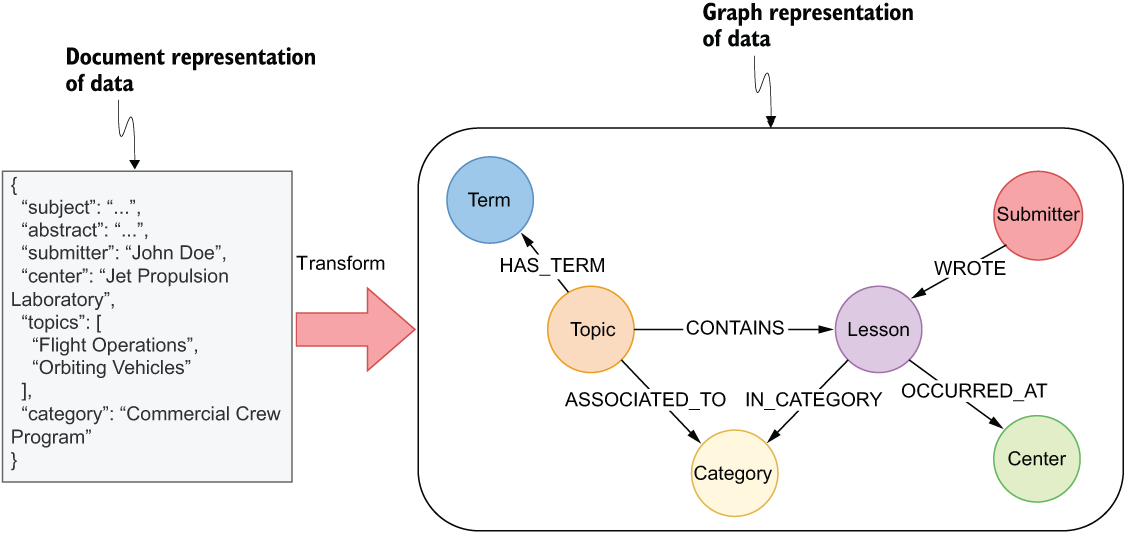
Compare a record-oriented view with a graph model: one lesson can become a node connected to the people, topics, and other information needed for exploration. section 1.0
A practical graph-database workflow is to:
- Identify a graph-shaped problem and decide which entities should become nodes and which connections should become relationships. section 2.0
- Import the dataset into a labeled-property graph, the graph model used for the practical modeling path. section 2.0
- Query the graph with Cypher to retrieve patterns, traverse connections, aggregate results, and explore the data. section 2.0
- Use the resulting graph for graph algorithms, inferred networks, or graph machine learning when those analyses fit the question. section 2.0
Building a graph from text
An NLP pipeline can turn unstructured text into graph data. After resolving references and recognizing entities, relation extraction can produce triples such as Jon–WORKS_AT–W3C and Jon–RESIDES–Bahamas. Storing those relationships in a graph database makes them available for querying, visualization, pattern finding, node classification, or link prediction. section 12.0
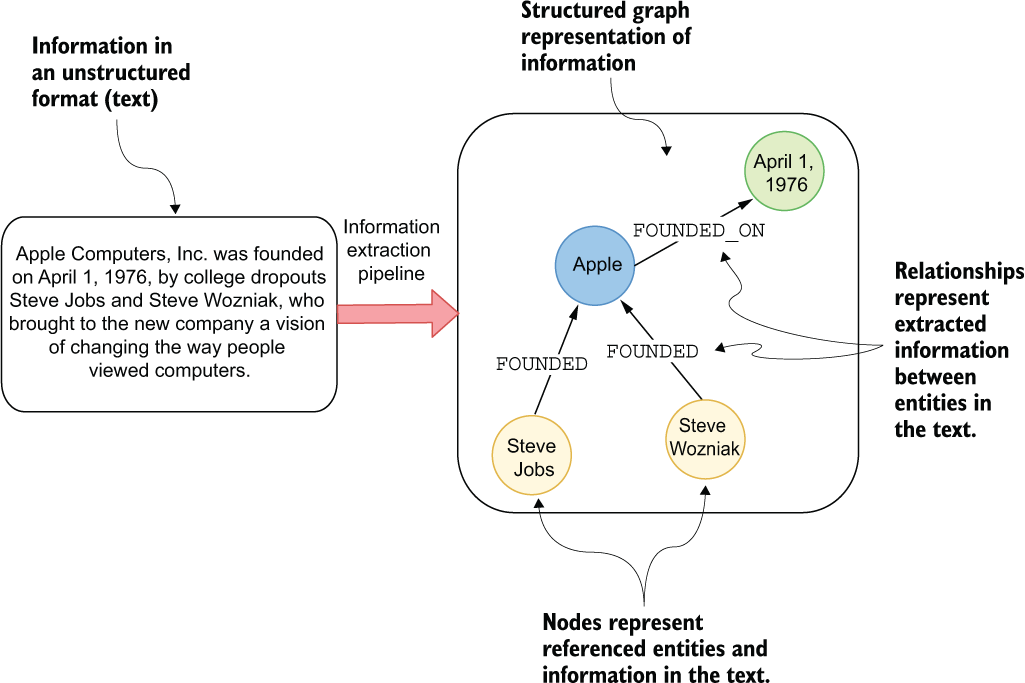
Use the pipeline diagram to trace how text becomes extracted entities and relationships, then becomes a queryable graph. section 12.0



