liveBook · Manning

GraphRAG

As explained in Essential GraphRAG

GraphRAG is a retrieval-augmented generation approach that incorporates graph-structured knowledge into information retrieval and response generation.

GraphRAG enhances retrieval-augmented generation with knowledge graphs, entity summaries, relationship summaries, and community summaries. It connects information scattered across documents so RAG systems can answer complex queries with richer, more explainable context. section 1.0 section 7.0

A typical GraphRAG workflow proceeds through these stages:

  • Define entity types suited to the questions and domain. section 7.1
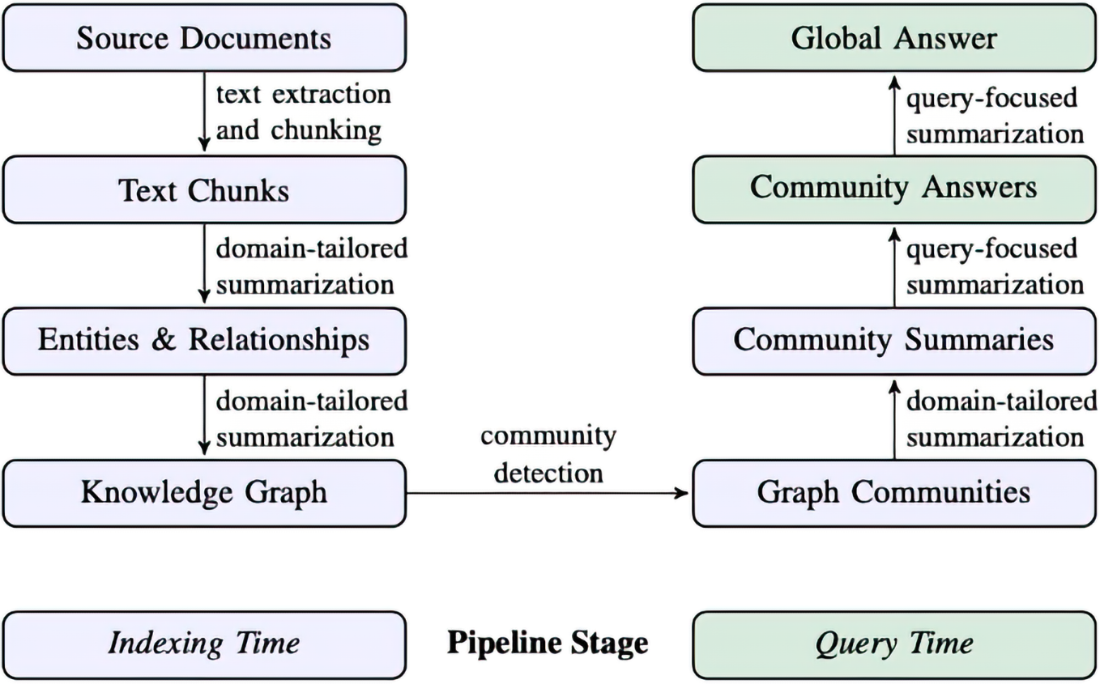
  • Extract and summarize entities and relationships from document chunks. section 7.0
  • Construct the knowledge graph, detect communities, and generate domain-specific community summaries. section 7.0
  • Retrieve context through global search across communities or local search around relevant entities. section 7.0

The Odyssey

The Odyssey provides recurring entities such as Ulysses, along with people, gods, and mystical weapons. Their appearances across text chunks support testing entity extraction and cross-chunk summarization. section 7.1

Figure 7.1 Microsoft’s GraphRAG pipeline. (Image from Edge et al., 2024, licensed under CC BY 4.0)
figure

Use the pipeline figure to inspect how documents become a knowledge graph, summaries, and retrieval-ready outputs. section 7.0
How Essential GraphRAG covers it

How deep it goes
Builds an end-to-end workflow from entity extraction through graph indexing, community summarization, and global or local retrieval.
Examples
Uses The Odyssey, recurring characters, gods, mystical weapons, and cross-chunk entity summaries as evaluation artifacts.
What it assumes
Requires unstructured documents, predefined entity types, and an empty local or cloud-hosted Neo4j instance.
What you can do after
Build it from scratch by modeling entities, constructing graphs, implementing retrieval workflows, and evaluating system quality.
How it connects
Connects retrieval-augmented generation, knowledge graphs, entity extraction, relationship extraction, community detection, and summarization.

Also explained in

Compare how 5 books explain GraphRAG →

Related concepts

This explainer was generated by Manning's knowledge graph from the text of Essential GraphRAG. The section links point to the parts of the book it draws on.