GraphRAG combines knowledge graphs with large language models to retrieve structured, relational context before generating an answer. It addresses vector-search failures such as noisy matches, missed entities, limited multihop reasoning, stale information, and weak transparency. A graph can combine curated facts, document text, metadata, and traceable source links, giving domain experts more control over the evidence used by the model. section 13.4.2 section 13.5
A practical GraphRAG pipeline can combine several retrieval paths:
- Represent entities, typed relationships, documents, and metadata in a knowledge graph. section 13.4.3
- Use the language model and graph schema to translate a natural-language question into a Cypher query. section 1.3 section 13.4.3
- Retrieve a connected subgraph, such as shortest paths between requested entities, when relationships provide the relevant context. section 13.4.3
- Use a graph-enhanced document retriever to select documents mentioning the required entities and preserve metadata and source traceability. section 13.4.3
- Give the retrieved graph and documents to the final model, then validate answers against the underlying evidence. section 13.4.5 section 1.3
Research-archive question answering
For “What did her fellow researchers say about Dorothy M. Wrinch?”, an agent first retrieves people connected to Wrinch, then finds the relevant source documents through a graph-enhanced retriever, and finally generates a factual answer from that context. Structured graph content can also answer questions such as shared research topics between Harvard University and Johns Hopkins University. section 13.4.5
Figure 13.5 Example of our Graph RAG agents’ internal steps. The agent starts with a thought that leads it to use the KG retriever to obtain a list of people who talked about Dorothy M. Wrinch. For each of them, it uses the KG-enhanced document retriever to identify the relevant documents. Finally, the agent uses all of this as a context for generating the final answer.
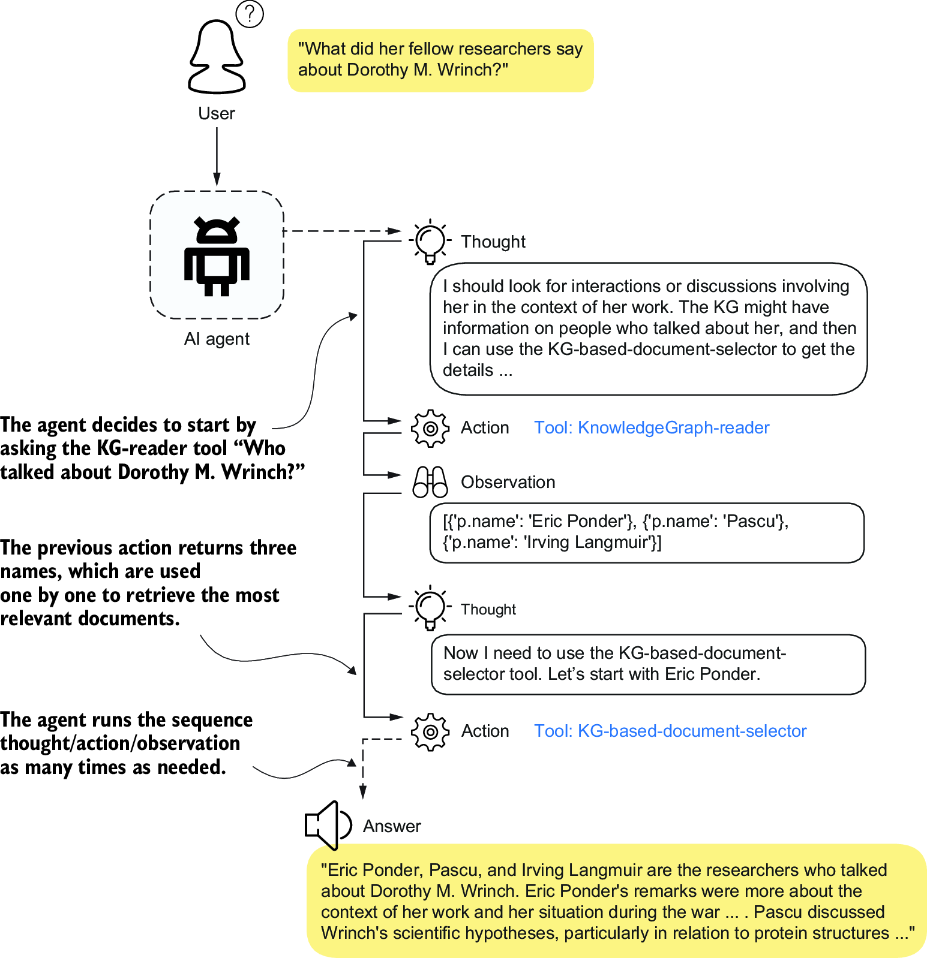
Shows the agent's thought, retrieval, observation, and answer-generation sequence for a grounded GraphRAG response. section 13.4.5




