Software delivery is a continuous cycle: intent becomes code, code is built and tested, the software runs, and observations feed back into intent. Work may return to earlier phases as tests fail, production behavior changes, or understanding of the problem evolves. section 1.2
Use the loop to locate friction rather than treating delivery as a fixed sequence. Lean principles—value, flow, pull, quality, and learning—apply across every phase and transition, from clarifying requirements to acting on production signals. section 1.2 section 1.2.5
Find where delivery slowed
If deployments shift from daily to weekly, check whether unclear requirements cause rework, tests are slow or brittle, deployments are blocked, or production feedback arrives too late. A pull request waiting three days may point to unclear requirements, flaky tests, or limited reviewer capacity. section 1.2
Figure 1.5 The holistic Lean model—five Lean principles surround and influence every phase of the work loop.
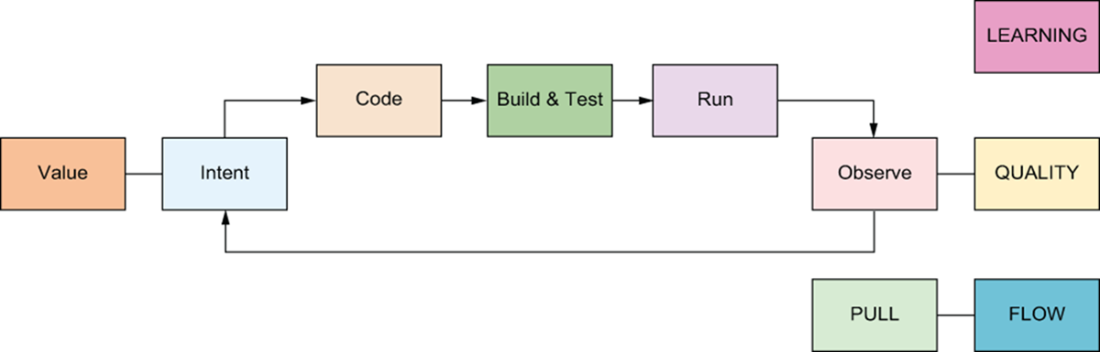
The figure shows the five Lean principles surrounding and influencing every phase of the work loop. section 1.2.5
