A creative programmer applies creative thinking to software work: not merely producing clever code, but finding, framing, testing, and communicating useful solutions. Creativity is a skill that can be developed through habits, curiosity, critical thinking, and practice rather than a fixed talent or a reward for technical experience alone. section 1.0 section 9.0
The role matters when familiar approaches stall or when the real problem has not yet been identified. A web application under heavy load, for example, may invite alternatives such as message queuing, load balancing, caching, or coroutines; generating possibilities helps a team escape circular thinking. Creativity is usually a means toward a product or solution, though it can also support self-expression, exploration, and play. section 1.2 section 5.7
Practice the role as a set of repeatable habits:
- Participate in new experiences and collect ideas, then connect them across interests to produce novel possibilities. section 6.2
- Move between diffuse and focused thinking; when ideas run dry, change modes rather than forcing the same approach. section 5.7
- Verify ideas and implementations, identify assumptions, and deliberately repair ignorance instead of waiting for accidents to expose it. section 5.4.3 section 5.7
- Treat criticism, unfamiliar tools, languages, hobbies, and collaborators as possible additions to a broader problem-solving toolkit. section 6.8
- Protect energy and product purpose: do not pursue beautiful code at the expense of what users need, and step back from creative overdrive when necessary. section 5.7 section 9.3
Check what the evidence actually says
A company’s first game was its best seller, its sequel reached a top-five chart, and the company was later acquired because a third sequel was expected to profit. Does the first game remain the company’s best seller? The answer is unknown: the sequel may have surpassed it later. The exercise trains a creative programmer to separate evidence from distracting assumptions before acting. section 5.4.3
“Creative” is also socially and contextually judged. A solution praised as an inventive workaround by one team may look routine to another, so seek feedback without confusing approval with proof. An open mindset matters in both directions: offer feedback with care, receive criticism as information, and remain aware of what you do not know. section 1.1 section 5.7
Figure 5.6 The online p5.js editor running a simple example of colliding spheres following the trajectory of sine waves. Once logged in, projects are easy to share: simply copy the URL. p5.js requires little knowledge of JavaScript since you’ll be relying on the well-documented Processing-specific functions, such as sphere.
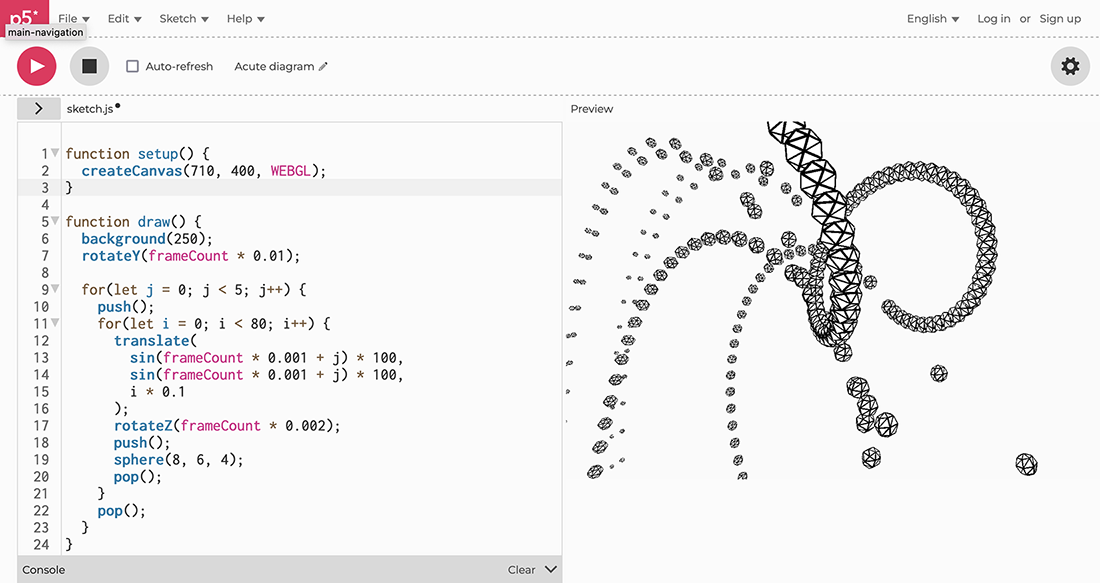
A p5.js scene of colliding spheres on sine-wave trajectories illustrates creative coding as playful exploration. Such environments can teach constraint-based thinking, but visual self-expression alone is not the whole role of creative problem solving. section 5.3
