Notes are external memory with a second job: helping ideas meet. Record what you learn, what worked, what failed, and why it mattered; then return to those records when a problem needs a fresh combination of knowledge. Collecting information alone is a trap if it never becomes code, writing, or another tangible result. section 2.4 section 2.2
A useful note system has a rhythm: capture, revisit, rework, connect, and act. Searchable digital notes can make old context easier to recover, but a notebook can retain useful personal context too. The important test is not how many notes exist, but whether they can be found and used. section 2.4 section 2.4.2 section 2.4.3
Treat different notes according to their purpose:
- Use temporary notes as restart cues after an interruption: write the next step, then discard the note once work resumes. section 2.4.4
- Use permanent notes to learn: add enough context and links that they can contribute to later thinking. section 2.4.4
- Maintain a growing collection: append or link useful material, restructure stale ideas, and prune notes that no longer help. section 2.4.3
- Separate thinking from doing: capture an obligation so it stops occupying attention, but schedule regular review so it can become action. section 2.4.2
A linked slip-box
Give a note an identifier and connect it to related notes. A sequence can continue linearly while lettered or nested identifiers branch from one idea; keyword index notes can point into larger themes. Following those links later can reconstruct an idea trail. Digital systems such as Obsidian and Zettlr draw inspiration from this approach. section 2.4.2
Figure 2.6 An example of the linking capabilities of Luhmann’s method. Zettel 1,5A2b, as seen in https://niklas-luhmann-archiv.de/bestand/zettelkasten/zettel/ZK_1_NB_1-5A2b_V.
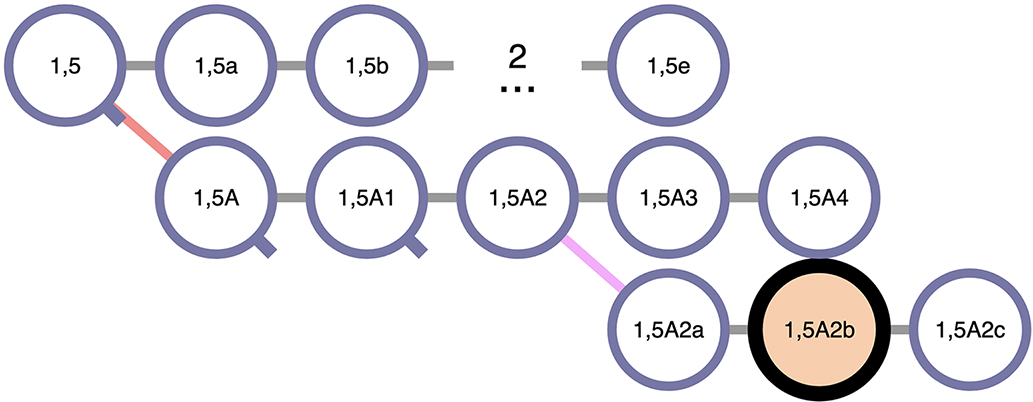
A numbered slip illustrates how an identifier can locate a note within a branching chain of related ideas. section 2.4.2
Start unceremoniously. For two weeks, capture what you learn each day—even an ugly sketch counts. Then reread the collection, notice any unexpected connection, cross-link it if useful, and ask what you could do with the resulting knowledge. Change the process if it gets in the way; note-taking is a skill that can begin with rules and become more contextual with practice. section 2.5.4 section 2.4.3
