The grounding layer acquires, stores, processes, represents, and delivers enterprise data for generative-AI applications. It connects source systems to LLM-compatible data, especially for retrieval-augmented generation (RAG). section 10.4 section 10.7
A grounding layer typically combines:
- Connectors, APIs, and plugins that handle different record systems, formats, protocols, authentication requirements, and data-refresh settings. section 10.2.3 section 10.4
- Batch and streaming data pipelines designed for high throughput and low delay. section 10.2.3
- Preprocessing, embedding models, and vector databases that make source data usable by LLMs. section 10.4
- Distributed processing frameworks that improve scalability and fault tolerance. section 10.2.3
RAG data path
Connect a system of record through a native API or plugin, ingest data through a batch or streaming pipeline, preprocess it for LLM use, create embeddings, and store the resulting vectors in a database such as Redis, Cosmos DB, Pinecone, Milvus, or Qdrant. section 10.2.3 section 10.4
Figure 10.4 GenAI app stack
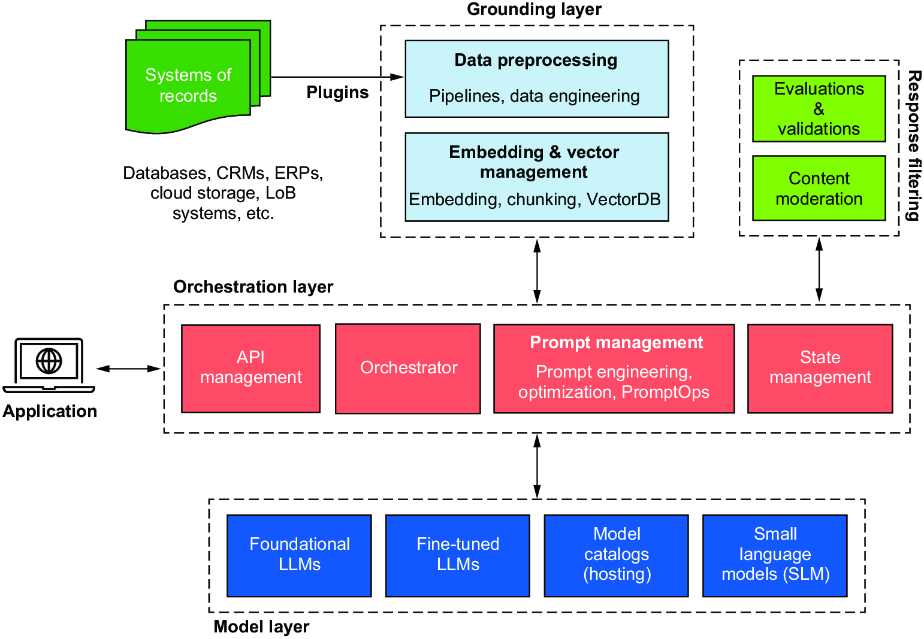
Use the GenAI app stack diagram to locate the grounding layer alongside the model, orchestration, and response-filtering layers. section 10.2.3
