A generative AI application stack is a reference architecture for connecting AI capabilities to an enterprise application. It builds on cloud-based distributed architecture rather than replacing it. The aim is to make models, enterprise data, application services, and safeguards work together around a business use case. section 10.0 section 10.2.1
Four core layers describe the working path through the stack: section 10.7
- The model layer provides access to models from different sources, including managed, fine-tuned, and bring-your-own models. APIs provide a controlled way to reach them. section 10.7
- The orchestration layer coordinates services, prompts, data flow, tasks, and error handling. Prompt management can use testing and interaction data to improve responses. section 10.2.3
- The grounding layer connects to systems of record, prepares enterprise data, and supports retrieval-augmented generation (RAG). Its pipelines, plugins, embeddings, and vector databases help make relevant data available to models. section 10.2.3 section 10.7
- The response filtering layer checks generated output for quality and suitability. Classifiers and natural-language processing tools can support checks for correctness, fairness, and content moderation. section 10.7
Figure 10.4 GenAI app stack
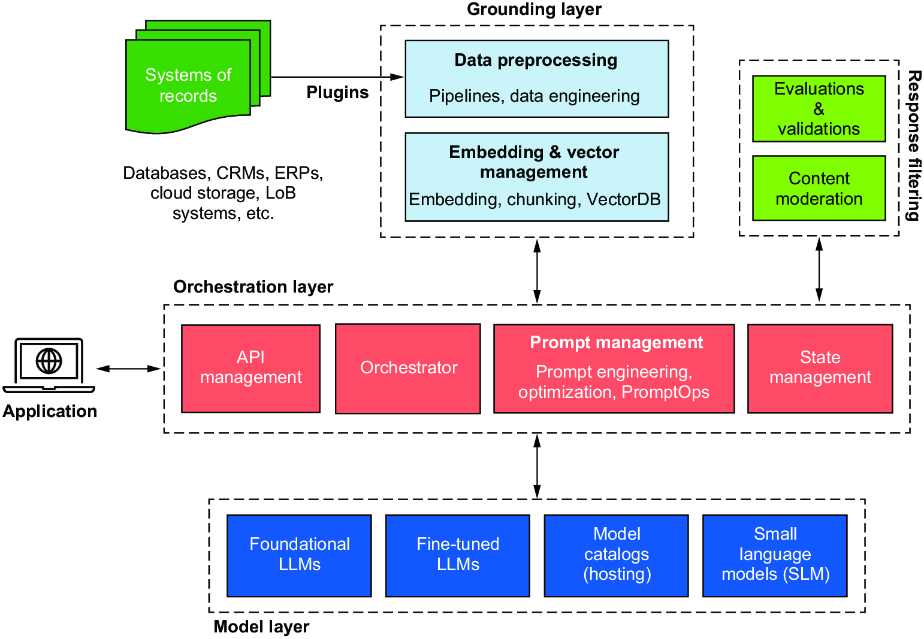
The stack diagram provides a visual reference for how its components are arranged. The detailed architecture groups components into six broad categories; the four layers above describe its core functional path. section 10.2.3 section 10.7
Enterprise customer-interaction workflow
Suppose an enterprise wants an AI-assisted customer interaction. Start with the business requirement, then expose AI services to the existing application through secure, maintainable APIs. A grounding pipeline could retrieve and prepare permitted data from a system of record for RAG. Orchestration would manage the prompts and service calls; the model would generate a response; filtering would check it before the interface presents it. This is an illustrative assembly of stack components, not a production deployment recipe. section 10.2.1 section 10.2.3 section 10.7
Implementation choices depend on data sensitivity and organizational policy: infrastructure may be on-premises, cloud-based, or hybrid. Plan for suitable storage and hardware, secure plugins, data protection, and user feedback. Orchestration frameworks such as Semantic Kernel, LangChain, and LlamaIndex can help coordinate application behavior; Kubernetes addresses deployment of containerized microservices. Neither choice removes the need to design the surrounding data and safety controls. section 10.2.1 section 10.2.3 section 10.7
