A group combines a set of elements with a binary operation such as addition or multiplication. Together, they support the algebraic behavior that makes key-exchange algorithms work. section 5.2.1
The set and operation form a group only when they satisfy four properties:
- Closure: operating on two elements produces another element in the same set. section 5.2.1
- Associativity: regrouping several operations does not change the result, so a(bc) equals (ab)c. section 5.2.1
- Identity: one element leaves every other element unchanged; multiplication commonly uses 1. section 5.2.1
- Inverses: every element has a partner that combines with it to produce the identity. section 5.2.1
Diffie–Hellman uses a multiplicative group, so multiplication is the chosen operation and the notation may omit the multiplication symbol. section 5.2.1
Figure 5.4 The four properties of a group: closure, associativity, identity element, and inverse element.
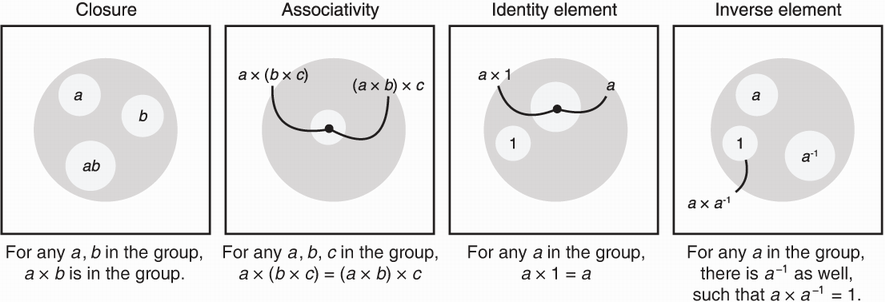
Use the figure to compare closure, associativity, identity, and inverse as four separate checks. section 5.2.1
