Group Relative Policy Optimization (GRPO) is a PPO-inspired policy-gradient method for RLHF that ranks several completions sampled for the same prompt. Rather than learn a value function to estimate how good each completion was, it treats the sampled group as its local comparison set: outputs rewarded above the group average receive positive advantage, while weaker outputs receive negative advantage. This makes GRPO particularly suited to settings such as reasoning training, where many candidate answers can be generated and scored for one problem. section 6.1 section 6.2.8
For a prompt s, generate G completions and assign rewards r₁ through rG. GRPO commonly computes each completion’s advantage by subtracting the group reward mean and dividing by the group standard deviation. That advantage is shared across every token in the completion. The policy update then uses a PPO-style clipped importance ratio, limiting how far the current policy can move from the rollout policy, and includes a KL penalty against a reference policy directly in the loss. section 6.2.8 section 6.3.6
Figure 6.7 GRPO architecture. Advantages are normalized relative to the group mean and standard deviation. The KL penalty is applied directly in the loss rather than shaping the reward.
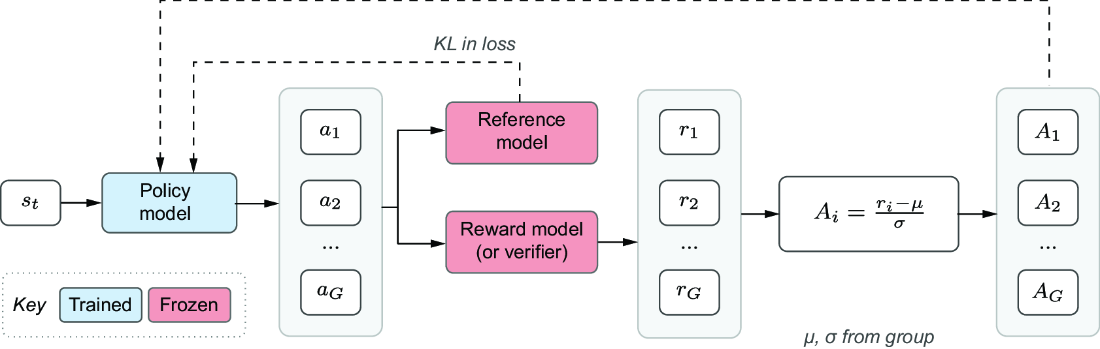
The architecture highlights the training flow: sample multiple answers per prompt, normalize their rewards within each group, apply the resulting advantages to token-level policy updates, and penalize KL divergence in the loss. section 6.2.8
Compared with nearby policy-gradient methods, GRPO changes the advantage estimator rather than abandoning PPO-style control:
- PPO uses a learned value function and per-token advantage estimation; GRPO removes the value model and derives advantages from completions in the same prompt group. section 6.2.11 section 6.2.8
- RLOO also compares multiple completions, but uses the average reward of the other samples as a leave-one-out baseline; group-centered GRPO advantage is proportional to that baseline before standard-deviation normalization. section 6.2.11 section 6.2.8
- GSPO retains group-relative advantages but uses a sequence-level policy ratio to address length bias, whereas GRPO uses token-level importance sampling. section 6.2.11
A grouped rollout update
For one reasoning prompt, generate several candidate solutions and score them. A solution scoring above that prompt’s group mean receives a positive normalized advantage, so its token probabilities are increased; a below-average solution receives a negative advantage, so they are decreased. In an implementation, rewards are reshaped by prompt and number of generations, group means and standard deviations are repeated for each completion, and the resulting advantages are broadcast over token positions before clipped policy losses are accumulated. section 6.3.6
Removing the value network can reduce memory use and avoids the unresolved problem of learning a value function from a language-model backbone. The trade-off is that GRPO needs multiple generations for every prompt and depends on relative reward variation inside each group. Its clipping, loss aggregation, and KL handling remain practical stability choices rather than guarantees of universal superiority. section 6.2.8 section 6.6


