liveBook · Manning

GRU

As explained in Vibe Engineering

A gated recurrent unit is a recurrent neural-network architecture that uses gating mechanisms to control information flow through a sequence.

A gated recurrent unit (GRU) processes words sequentially, retaining important context from earlier words so later words can be interpreted. In a classification pipeline, it follows word embeddings and SpatialDropout1D, then passes its learned representation to a Dense layer with sigmoid output. section 4.6.6

Text classification pipeline

Words such as "nausea" and "vomiting" become vectors, pass through dropout and a GRU, and produce a probability between 0 and 1 for a classification task. The surrounding pipeline also compensates for rare high-risk cases with class weights. section 4.6.6

Figure 4.12 The classification pipeline architecture
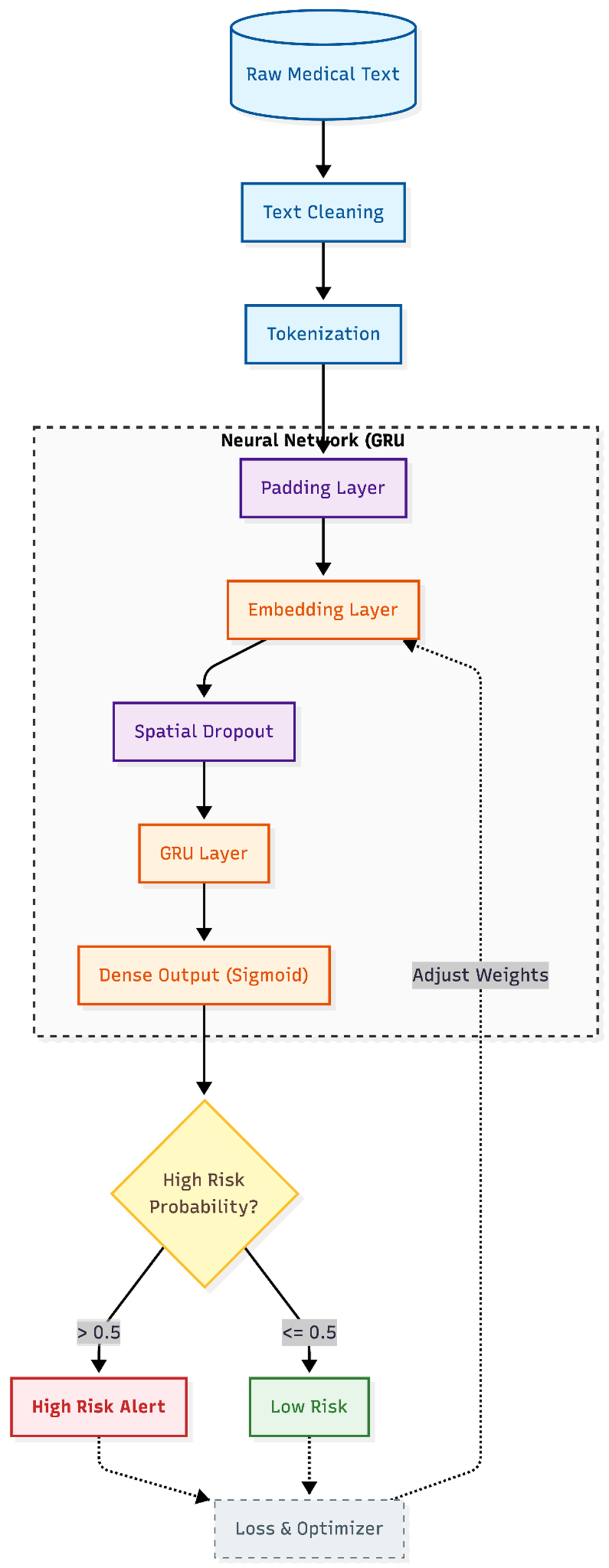
Use the pipeline architecture figure to trace data from word embeddings through the GRU to the final classifier. section 4.6.6


How Vibe Engineering covers it

How deep it goes
Explains sequential reading and context retention at the architecture level.
Examples
Uses nausea and vomiting embeddings and drug-description classification as concrete sequence-processing examples.
What you can do after
Evaluate/understand how a GRU fits into a text-classification data flow.
How it connects
Connects GRUs to word embeddings, dropout, dense layers, sigmoid outputs, and class-imbalanced classification.

Also explained in

Compare how 10 books explain GRU →

Related concepts

This explainer was generated by Manning's knowledge graph from the text of Vibe Engineering. The section links point to the parts of the book it draws on.






