A guest operating system is an operating system running inside a virtual machine. The hypervisor allocates hardware resources to it, while the host OS runs directly on the physical hardware when using a type 2 hypervisor. section 17.1.1 section 17.4
Key operational distinctions:
- Runs as a complete OS for its applications, unlike a container, which packages an application and its dependencies without an independent OS. section 17.4
- Operates as an independent network host through a virtual NIC; a virtual switch forwards traffic between guest systems and the host’s physical NICs. section 17.4
- Can use access or trunk virtual-switch ports, allowing VLAN segmentation between virtual machines. section 17.4
- Type 2 virtualization is easy to install on a personal computer but uses resources less efficiently because it depends on the host OS. section 17.1.1
Desktop virtualization
A Mac or Linux user can run a Windows guest OS through a type 2 hypervisor, avoiding the need to purchase another computer. This arrangement also supports development, testing, and education. section 17.1.1
Figure 17.5 A type 2 hypervisor runs as an application on a host OS.
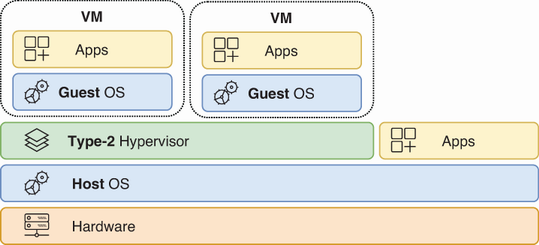
Shows the host OS beneath a type 2 hypervisor and the guest virtual machines above it. section 17.1.1
