Half-duplex communication allows transmission in both directions, but only one device can transmit at a time. Wireless LANs use this mode because devices share an unbounded medium; simultaneous transmissions can collide. section 18.1.1
Wireless devices contend for airtime by listening before transmitting. CSMA/CA makes a device wait when the channel is busy, then transmit when it senses a free channel; simultaneous transmissions can still require retransmission. section 18.1.1
Key networking contrasts:
- A wireless device’s signals can reach all devices within sufficient range, resembling frames flooded through an Ethernet hub. section 18.1.1
- Wireless half-duplex operation helps explain why wireless networks often do not match the speeds of switched Ethernet operating in full-duplex mode. section 18.1.1
Figure 18.3 The CSMA/CA process. To avoid collisions, a device will listen to ensure the channel is free before transmitting a frame.
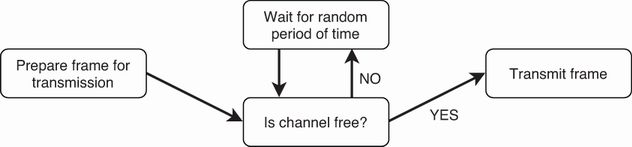
Trace the simplified CSMA/CA sequence: listen, wait if busy, and transmit when the channel is free. section 18.1.1

