How could an early AI system respond to language? A handcrafted rule gives it an explicitly written condition and action: when a situation matches, perform the behavior the designer specified. section 1.4
Handcrafted rules differ from systems that learn patterns from examples:
- A rule-based system operates only inside situations its designers anticipated. section 1.4
- A learning system discovers patterns from data instead of receiving every behavior explicitly programmed. section 1.2
ELIZA and the limits of written rules
ELIZA could imitate conversation, but its responses depended entirely on hand-written rules. It could handle expected situations and struggled when a user's input fell outside those encoded in advance. section 1.4
Figure 1.6 A high-level timeline of language models and AI systems (1950s–present), showing the progression from early rule-based systems and chatbots to neural networks, sequence models, and modern large language and multimodal systems, along with recurring cycles of progress and setbacks known as AI winters.
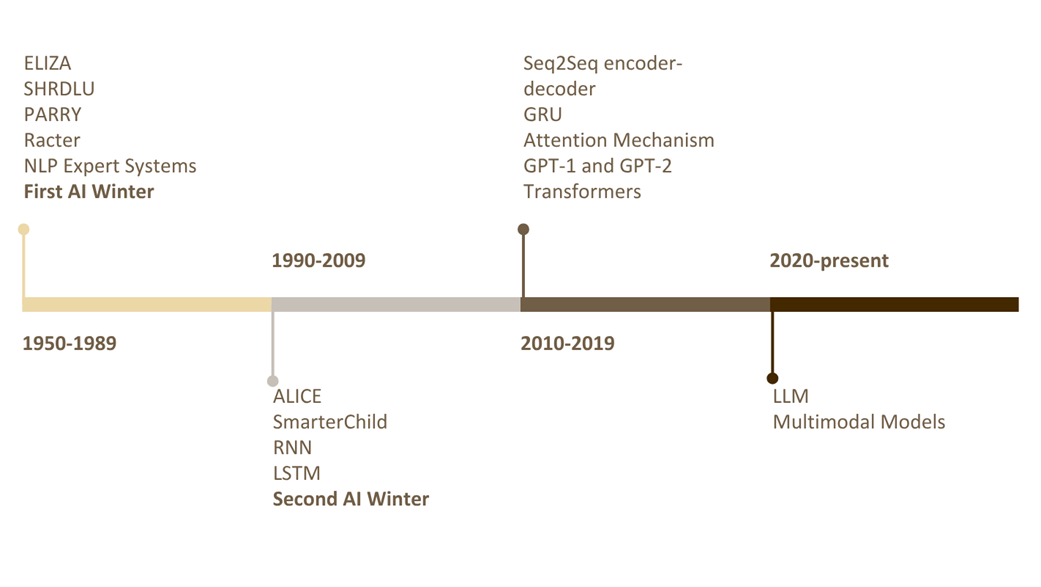
Trace the progression from early rule-based systems and chatbots to neural networks and modern language models. section 1.4