ELIZA can sound thoughtful without understanding anything. It detects keywords, matches familiar sentence patterns, and places extracted phrases into predefined response templates. section 1.1
Its response process is simple:
- Scan the input for keywords such as “feel,” “my,” or “think.” section 1.1
- Match a structure such as “I feel X” or “I think X.” section 1.1
- Reuse part of the sentence inside a fixed question template. section 1.1
A convincing but empty exchange
User: I feel unhappy about my job ELIZA: Why do you feel unhappy about your job? The reply sounds relevant because it mirrors the user’s words and resembles a therapist’s open-ended question. Yet it does not interpret the situation, recognize emotion, or form an opinion. When language falls outside anticipated patterns, the response may remain grammatical while missing what matters. section 1.1 section 1.1.1
Figure 1.1 The general mechanism of rule-based systems. A fixed rule library written in advance by humans defines the set of triggers, conditions, and actions the system can recognize. When input arrives, the rule-based system scans for a matching condition and fires the associated action. No learning occurs: the system can only handle situations its designers anticipated. Anything outside the ruleset causes failure or a degraded response. ELIZA is a direct instance of this architecture.
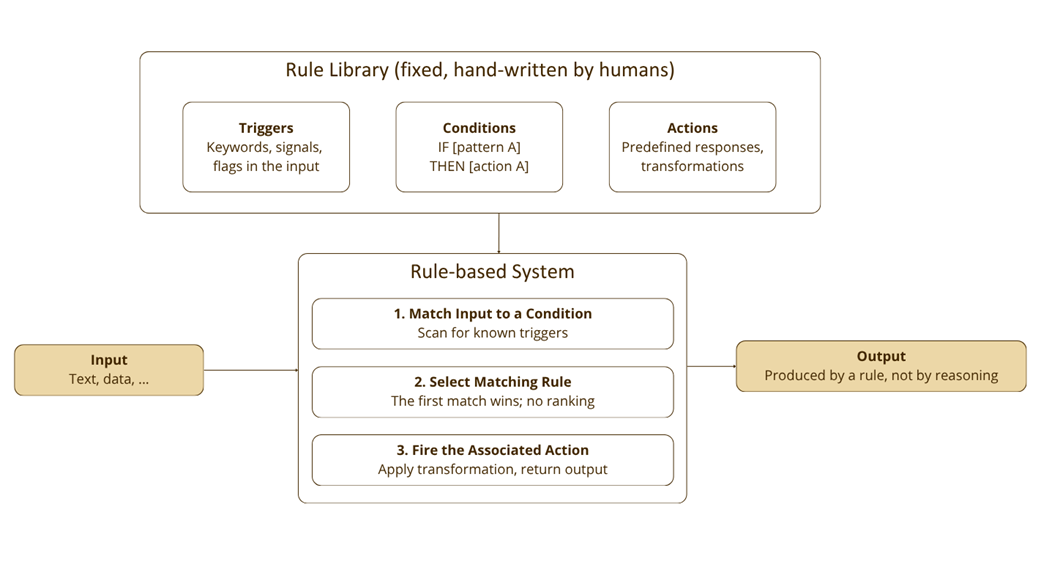
Trace ELIZA as a fixed rule-based pipeline: input triggers, matching conditions, and predefined actions, with no learning beyond the rules designers supplied. section 1.1.1