liveBook · Manning

Hard clustering

As explained in Retrieval Augmented Generation, The Foundational Ideas

Hard clustering assigns each item exclusively to one cluster rather than allowing graded membership across clusters.

Hard clustering assigns each text chunk entirely to one cluster, forcing a binary decision when semantic boundaries overlap. This can sever relationships between related topics and hide context behind an arbitrary classification boundary. section 10.3.2

In hierarchical retrieval, exclusive assignment can prevent a chunk from contributing to multiple parent summaries. The approach contrasts with soft clustering, which preserves overlapping semantic relationships through probabilistic membership. section 10.3.2

An insolvency paragraph

A paragraph about “Insolvency” must belong entirely to either “Termination” or “Financial Risk.” Assigning it to only one cluster loses its connection to the other topic and can cause context loss. section 10.3.2

Figure 10.4 Gaussian Mixture Models (GMM) and Soft Clustering.
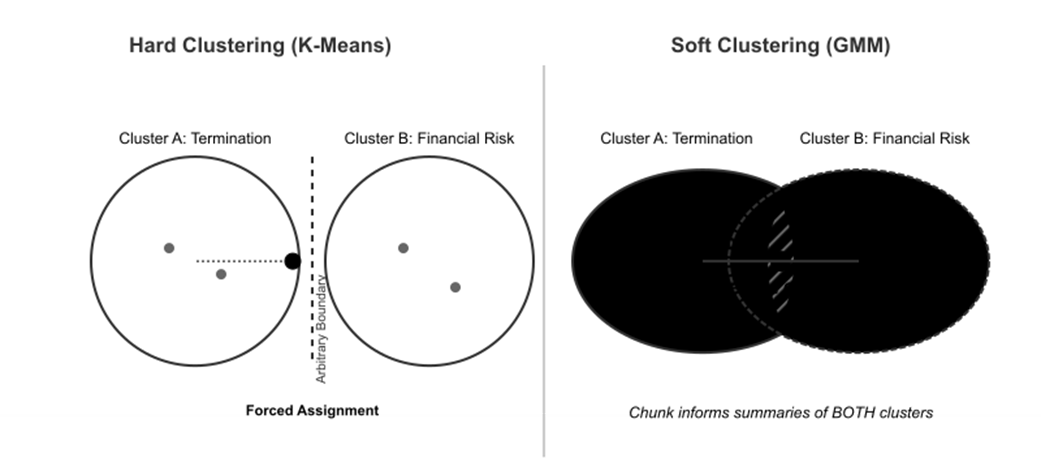
Compare the hard-clustering boundary with overlapping Gaussian Mixture Model distributions, where one chunk can bridge multiple semantic clusters. section 10.3.2


How Retrieval Augmented Generation, The Foundational Ideas covers it

How deep it goes
Contrasts binary assignment with probabilistic overlap and stops short of detailing a hard-clustering algorithm.
Examples
Uses an Insolvency paragraph assigned exclusively to either Termination or Financial Risk.
What you can do after
Evaluate whether exclusive cluster boundaries risk losing cross-topic context in retrieval hierarchies.
How it connects
Connects hard clustering to soft clustering, Gaussian Mixture Models, K-Means, and hierarchical retrieval.

Also explained in

Compare how 3 books explain hard clustering →

Related concepts

This explainer was generated by Manning's knowledge graph from the text of Retrieval Augmented Generation, The Foundational Ideas. The section links point to the parts of the book it draws on.
