Safety is the degree to which an AI system avoids harmful or unacceptable behavior. It is evaluated alongside helpfulness and honesty because optimizing one dimension can damage another. section 2.3.2 section 8.1.2
A useful diagnostic question is whether a system refuses genuinely harmful requests without refusing legitimate, borderline requests. Blanket refusals can maximize apparent safety while making the assistant evasive and useless. section 8.1.2 section 8.2.5
Evaluate safety through several connected lenses:
- Balance safety with helpfulness rather than allowing a high score in one dimension to hide failure in the other. section 2.3.2
- Distinguish principled alignment from policy-based alignment: values such as harmlessness differ from procedural rules about which requests to refuse. section 8.1.4
- Inspect the quality and consistency of the feedback signal, because labeler preferences can be noisy and may reward safe-sounding non-answers. section 7.5.2 section 8.1.2
- Use written principles and AI-generated critiques to explain why an answer is harmful, rather than training refusal as the only safe behavior. section 8.0 section 8.2.5
Imbalanced evaluation
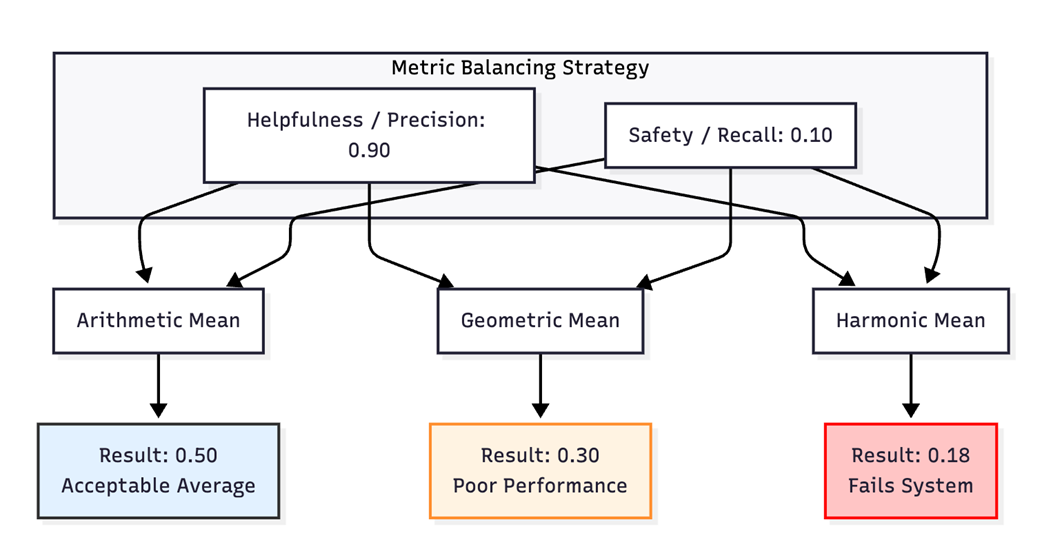
Suppose helpfulness scores 0.90 while safety scores 0.10. The arithmetic mean is 0.50, whereas the geometric and harmonic means fall to 0.30 and 0.18. The stricter aggregates prevent helpfulness from masking a serious safety failure. section 2.3.2
Figure 2.5 Impact of mean selection on imbalanced objectives. When evaluating a system with high helpfulness (0.90) but low safety (0.10), the choice of mean determines the pass/fail outcome. The arithmetic mean suggests acceptable performance (0.50). The geometric mean imposes a moderate penalty (0.30). The harmonic mean (0.18) enforces the strictest penalty for the imbalance, ensuring safety cannot be compromised for helpfulness.
Compare arithmetic, geometric, and harmonic aggregation for systems with imbalanced helpfulness and safety scores. section 2.3.2











