Harness engineering builds constraints and supporting mechanisms around an AI agent. When an agent makes a mistake, the goal is to engineer a solution that prevents it from recurring. The agent generates candidate implementations; engineers define acceptable behavior and evaluate the results. section 1.4.1
The harness allocates resources and governs how the agent works. In a pull-request review, execution topology can route a simple rename to a quick check and a caching-layer change to deeper analysis, trading latency and cost for scrutiny. section 1.4.1
Figure 1.4 The seven cognitive functions for processing a pull request review. The arrows show information flow. The dashed box shows governance controls reaching across the pipeline; the four governance patterns retain their matrix coordinates.
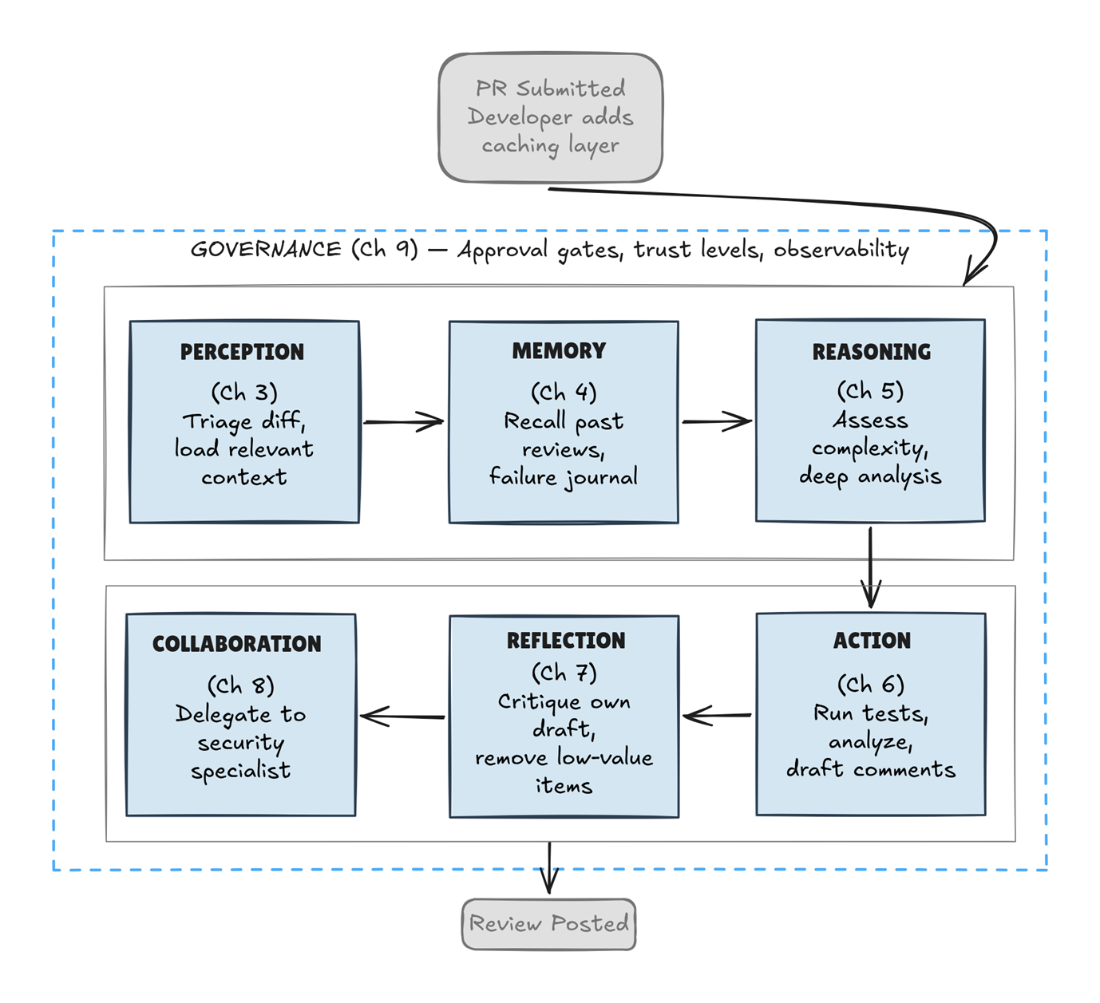
The pull-request review pipeline shows information flowing through seven cognitive functions, with governance controls spanning the pipeline. section 1.4.1
Harness design can change performance without changing the model. On TerminalBench 2.0, harness optimization moved one model from below baseline to a top-five finish. In another case, removing 80% of an agent’s tools reduced steps and token use while speeding responses. section 1.4.1
