A hash value is the fixed-size, deterministic output of applying a hash function to input data of arbitrary length. Reversing the output to recover the input should be computationally impractical. section 6.1
Hash values act like one-way fingerprints: identical inputs produce matching values, while even a small input change usually produces a radically different value. This supports password verification and file-integrity checks without storing the original data. section 6.1 section 7.1
Use hash values carefully:
- Store a password’s digest and hash the login attempt again; matching values permit login. section 6.1
- Compare a downloaded file’s digest with a published checksum to detect accidental corruption. section 7.1
- Do not treat an ordinary hash value as authentication: an attacker can replace both a message and its digest. section 7.1
Figure 6.1 Hash functions use one-way functions to calculate a fixed-length hash digest from a variable-length input message.
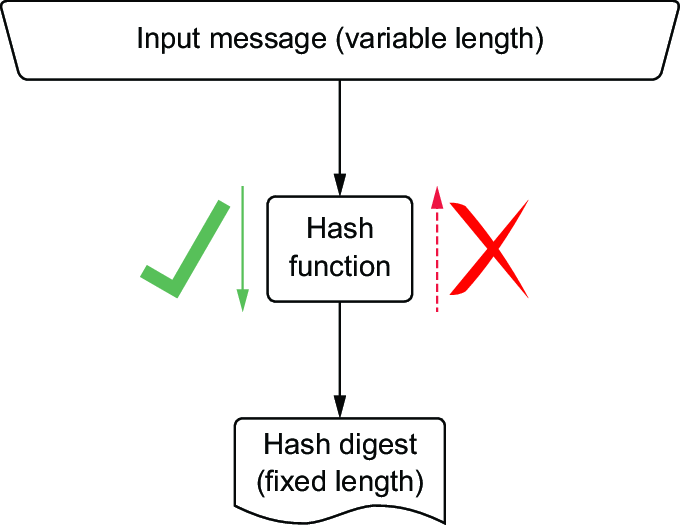
Shows the transformation from a variable-length input message to a fixed-length digest through a one-way function. section 6.1






