liveBook · Manning

Headroom

As explained in 100 SQL Server Mistakes and How to Avoid Them

Capacity headroom is reserved unused resource capacity intended to absorb unexpected workload growth or demand variation.

Headroom is reserved unused capacity for unexpected workload growth. Treating current free space as sufficient can hide retention requirements, system-database growth, and demand changes. section 9.6

Mistake: counting today’s free space

A database has 200 GB of data files and 50 GB free, but consumes 5 GB daily and retains data for three years. After one year, the files could reach 1.78 TB; TempDB, the transaction log, and unexpected growth may raise total need to about 3.2 TB. If only 2 TB remains on the SAN, expansion can trigger difficult business negotiations and prolonged downtime. section 9.6

Plan headroom by checking:

  • Retention period and current consumption rate. section 9.6
  • Data files, TempDB, transaction-log requirements, and unexpected growth. section 9.6
  • Whether available SAN capacity is already committed elsewhere. section 9.6
Figure 9.5 Linear growth pattern
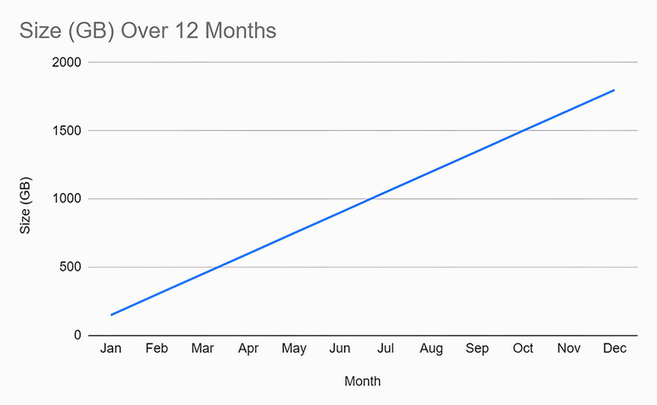
Compare linear growth with the supplied exponential-growth figure before estimating headroom. section 9.6

How 100 SQL Server Mistakes and How to Avoid Them covers it

How deep it goes
Calculates linear growth and identifies related capacity needs, but stops short of prescribing a detailed forecasting procedure.
Examples
Uses a 200 GB database, 50 GB free space, 5 GB daily intake, three-year retention, and a constrained corporate SAN.
What it assumes
Assumes basic awareness of database storage and teaches capacity estimation through a concrete growth scenario.
What you can do after
Evaluate storage requirements by projecting retention growth and adding system-database, log, and unexpected-growth capacity.
How it connects
Connects headroom with capacity planning, data retention, TempDB, transaction logs, SAN capacity, and linear or exponential growth.

Related concepts

This explainer was generated by Manning's knowledge graph from the text of 100 SQL Server Mistakes and How to Avoid Them. The section links point to the parts of the book it draws on.