Apparent complexity estimates how difficult it is to describe a system’s coarse-grained state. A short compressed description indicates simplicity; a long one suggests visible structure. Unlike entropy, which tracks microscopic disorder, apparent complexity can be high when large-scale patterns emerge. section 8.1.1
To estimate it, average groups of cells into a coarse-grained array, save the array, and compress it with a standard tool such as gzip or bzip2. The compressed size serves as a practical proxy for Kolmogorov complexity, the length of the shortest program that reproduces an object; the true value is uncomputable in practice. section 8.1.1
Cream mixing into coffee
As cream mixes into coffee, entropy rises steadily, but apparent complexity first rises and then falls. The coarse-grained image is simple at the start and end, but irregular gray regions make it harder to compress at an intermediate stage. Interacting dynamics produce a larger complexity peak than noninteracting diffusion. section 8.1.2
Figure 8.3 In the simulation of coffee and cream mixing, entropy (top, monotonic curve) steadily increases toward a maximum as the fluids randomize, in accord with the Second Law. Apparent complexity (bottom, nonmonotonic curve) first increases, then decreases, peaking at an intermediate time when the system’s state is most “interesting,” or structured. Used with permission granted by the lead author (Scott Aaronson).
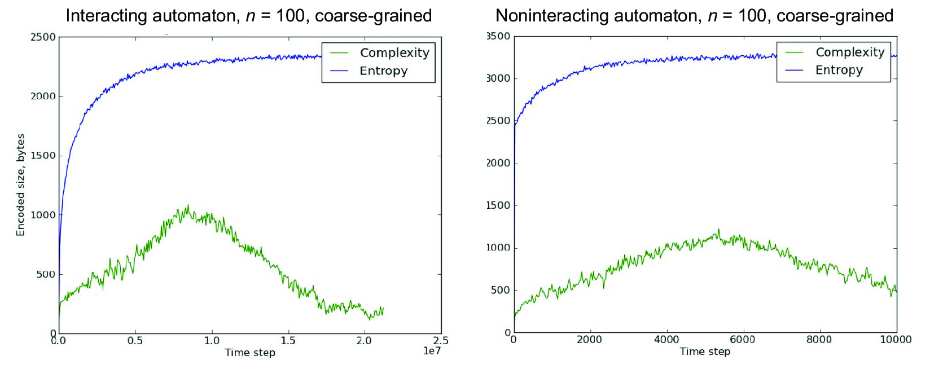
The figure contrasts steadily increasing entropy with apparent complexity peaking during intermediate mixing. section 8.1.2
