A coarse-grained array turns a detailed grid into a lower-resolution view of its larger patterns. In the cream-and-coffee mixing example, each entry averages a small neighborhood, then is quantized into labels such as coffee, cream, or mixed. This removes microscopic speckles while preserving features such as the boundary between the two fluids. section 8.1.1
The array represents a macrostate for estimating its description length: it is compressed with a standard compressor, while entropy is estimated from the full, fine-grained state. The two views focus on different scales. section 8.1.1
Figure 8.2 Illustration of the construction of the coarse-grained array using an example grain size of 3. The values of the shaded cells on the left are averaged to produce the value of the shaded cell on the right. Used with permission granted by the lead author (Scott Aaronson).
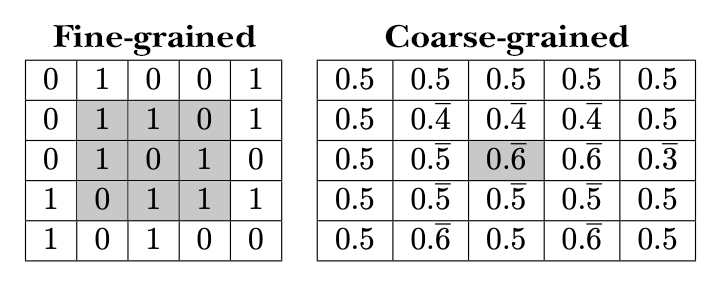
The figure illustrates how averaging a neighborhood with grain size 3 produces one coarse-grained cell. section 8.1.1
