Dense prediction needs broad context without losing pixel-level detail. A context module stacks convolutions with increasing dilation rates, such as 1, 2, 4, and 8, to expand the receptive field while preserving full resolution. In Yu and Koltun’s 2015 approach, this helped address the resolution trade-off in ResNet-like architectures. section 3.5
The design connects receptive field, resolution, and model complexity:
- Dilation inserts gaps between kernel elements, enlarging the receptive field without increasing the parameter count per layer. section 3.5
- The segmentation model modified VGG-16 by removing pooling and striding layers and replacing them with dilated convolutions. On PASCAL VOC, it exceeded leading models by more than five percentage points in mean pixel IoU. section 3.5
Figure 3.6 Dilated convolutions rapidly expand the receptive field without increasing computational cost. Each dot represents a convolutional kernel element. As dilation increases (from left to right), the receptive field expands exponentially, capturing broader spatial context while keeping the parameter count the same. Used with permission granted by the lead author (Fisher Yu).
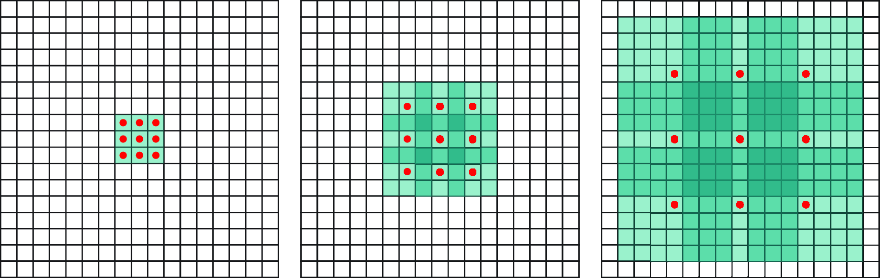
See how increasing dilation expands the receptive field while keeping the convolution kernel elements—and parameter count—unchanged. section 3.5
