An application should not have to change its core logic when an RSS library, database, or HTTP framework changes. Hexagonal architecture, also called ports and adapters, puts domain entities and interfaces at the center. Concrete adapters connect external systems to those interfaces; the domain does not import the adapters. section 11.1.2
A Go news application can establish that boundary with a few focused types:
- Keep Article and Feed in a domain module, independent of infrastructure packages. section 11.1.2
- Define ports for needed behavior: Fetcher retrieves a Feed, ArticleReader reads articles, and Storage adds persistence. section 11.1.2
- Let implementation modules import the domain, never the reverse. A worker can receive a Fetcher and Storage without depending on their concrete types. section 11.1.2 section 11.3.3
Figure 11.4 Hexagonal architecture: Domain at the center with ports and adapters
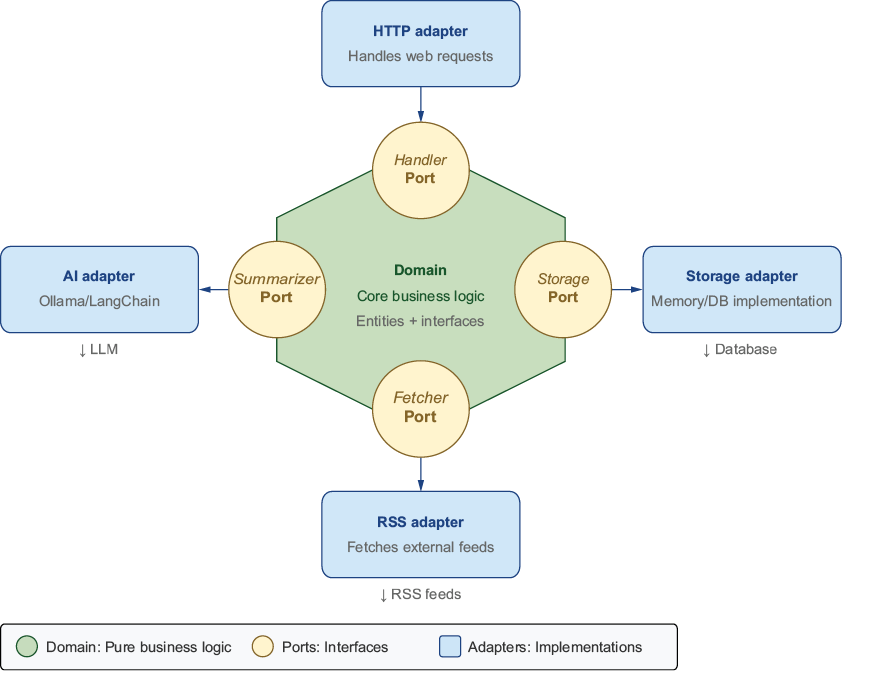
The diagram shows the domain at the center, with interfaces as ports and external implementations as adapters. section 11.1.2
An RSS adapter
RSSReader implements domain.Fetcher using gofeed. Its FetchFeed method converts library-specific feed and item values into domain Feed and Article values before returning them. The declaration `var _ domain.Fetcher = (*RSSReader)(nil)` makes an interface mismatch a compile-time error. Replacing the RSS library would change this adapter, not the domain types or code that consumes Fetcher. section 11.3.3 section 11.1.2
The same boundary helps testing: a mock Fetcher can return predetermined data in place of a live RSS reader. The practical test of the design is whether consumers work with either implementation through the same interface. section 11.1.2 section 11.4





