A hierarchical architecture organizes a campus LAN into modular layers with distinct operational roles. Cisco campus designs may use one, two, or three layers depending on site requirements. section 15.2
The layers divide campus responsibilities as follows:
- Access layer: connects end hosts and commonly implements QoS, security services, and PoE. section 15.5
- Distribution layer: aggregates access connections and connects the LAN to the WAN or internet. section 15.5
- Core layer: aggregates connections between distribution layers in larger LANs. section 15.2
Modular layer blocks support incremental expansion. A two-tier design contains access and distribution layers and is also called a collapsed-core architecture; a three-tier design adds the core layer. section 15.2 section 15.5
Figure 15.2 A three-tier campus LAN spanning three buildings. End hosts connect to the access layer, the distribution layer aggregates connections from the access layer, and the core layer aggregates connections from the distribution layer.
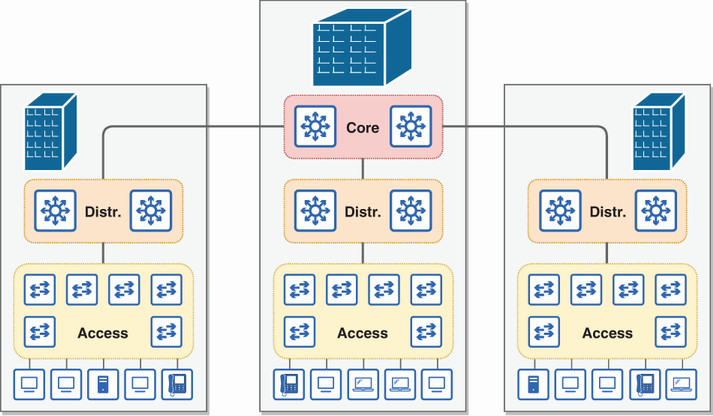
Use the three-building diagram to trace end-host connections through access, distribution, and core layers. section 15.2
