Hierarchical virtual screening reduces a large compound library through successive stages, beginning with fast, inexpensive filters and ending with rigorous methods applied to a small candidate set. section 2.1.1
A practical pipeline can proceed as follows:
- Apply rule-based compound filters to remove obvious candidates of concern, including compounds with poor drug-likeness. section 2.1.1
- Use ligand-based virtual screening to identify compounds resembling known active molecules. section 2.1.1
- Apply protein-ligand docking or molecular dynamics simulations to the remaining compounds when a target structure is available. section 2.1.1
Figure 2.1 Virtual screening pipelines are often hierarchical, proceeding with a broad, large number of compounds through simpler, less restrictive, and computationally cheaper processes to whittle down the quantity of compounds. If the 3D structure of the target is not defined, we’re restricted to ligand-based virtual screening. If it is defined, then we can explore structure-based virtual screening, potentially as a downstream component to ligand-based virtual screening.
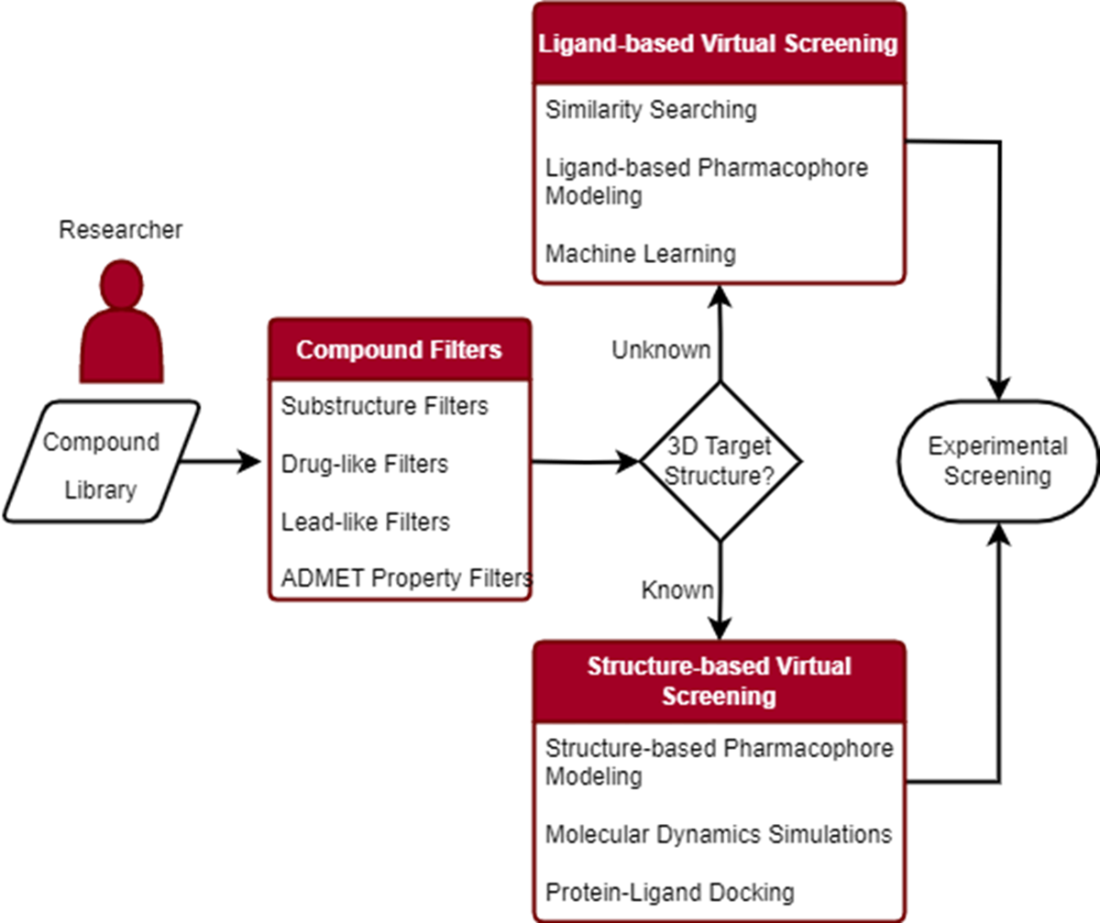
The pipeline moves from many compounds and simpler computations toward fewer compounds and more intensive analysis; target structure availability determines whether structure-based stages can follow. section 2.1.1
