Ligand-based virtual screening prioritizes compounds using information about known ligands, rather than an explicit target structure. A ligand is a compound that interacts with a biological target. When the target’s three-dimensional structure is unavailable, known active compounds can still guide the search for promising candidates. section 1.3.2 section 2.1.1
The choice of method depends on the compounds and activity labels available. An active compound has the property being assessed; an inactive compound lacks it. section 2.1.1
Common approaches include:
- Similarity search: compare one or more known active compounds with a library. Compounds with similar structures or properties may also be active. section 2.1.1
- Pharmacophore search: use several active compounds to find shared structural features across possible three-dimensional configurations, then search for compounds with high-scoring features. section 2.1.1
- Machine learning: use many known active and inactive compounds to learn relationships between structural features and activity, then predict activity for new compounds. section 2.1.1
Figure 2.2 Regarding ligand-based strategies, machine learning becomes available if we have examples of both positive class and negative class compounds within our data. If we only have examples of positive class compounds, then search based strategies are more appropriate. Positive class means the compound is “positive” for the property we are assessing whether it be activity, toxicity, or some other property.
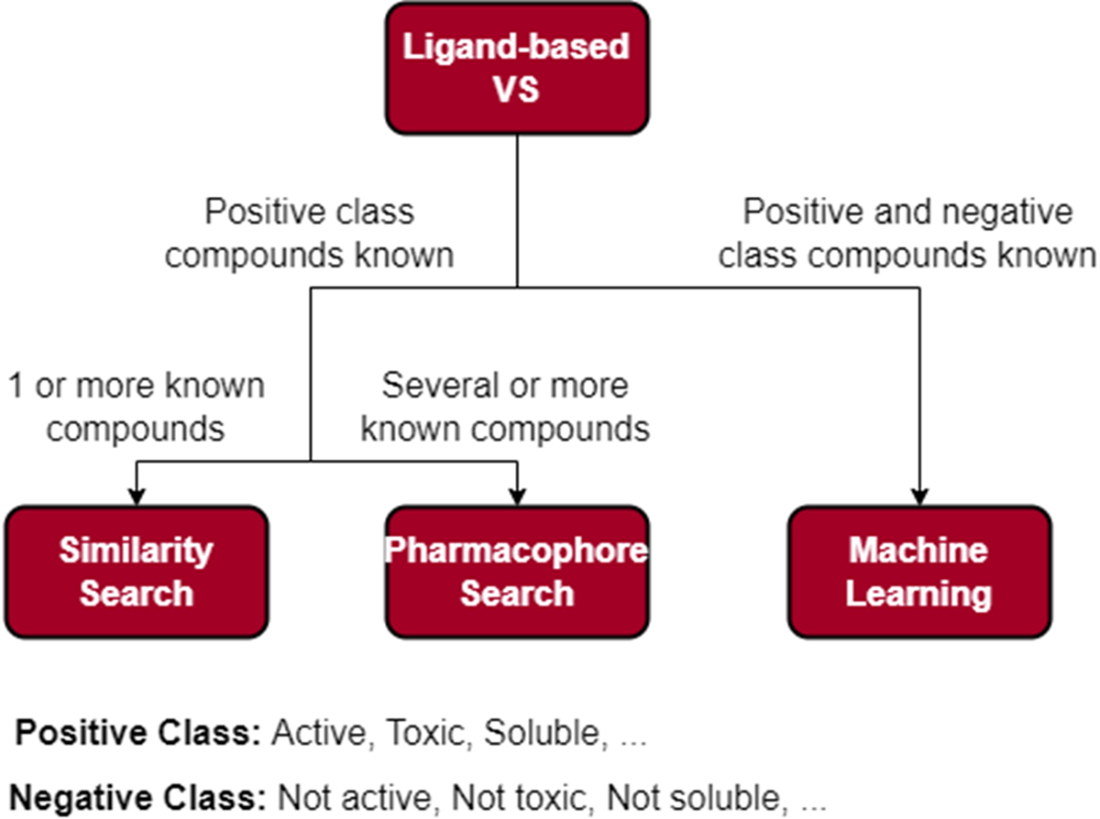
Use the available positive and negative examples to choose between search-based and machine-learning strategies. section 2.1.1
Antimalarial screening and cardiotoxicity
An antimalarial campaign starts with more than 212,000 commercially available small molecules from the SPECS repository and searches for compounds similar to known antimalarials. Promising hits can then be screened for blockage of the hERG potassium channel, an antitarget associated with cardiotoxicity. A predicted non-blocker is not necessarily safe: it is only predicted to lack this particular liability. Low-confidence predictions can be deferred for experimental follow-up. section 2.1.2 section 3.1
Screening is often hierarchical: inexpensive steps narrow a large library before more demanding follow-up. Predictions prioritize candidates for experiments; a model must also generalize beyond its training compounds and fit the campaign’s goals and constraints. section 2.1.1 section 3.1
