Abstractions are compact, reusable structures mined from experience. They let intelligence make sense of unfamiliar situations by recombining known elements into a model suited to the moment. section 19.3.2
Treat abstraction as two coupled capabilities:
- Acquire abstractions by extracting underlying structures, principles, or invariants from data or experience. section 19.3.2
- Recombine abstractions on the fly to model novel problems instead of retrieving only a fixed training-time representation. section 19.3.2 section 19.4
- Compare instances by similarity to form value-centric prototypes, or by exact structural match to isolate program-centric abstractions. section 19.4.1
Beetles become prototypes
After seeing beetles from several species, cluster similar instances and merge each cluster into a prototype. A new beetle can then be compared with a few prototypes rather than every remembered instance, supporting predictions about its category and behavior. section 19.4.1
The two modes complement one another. Similarity-based abstraction is continuous, fuzzy, and useful for perception and intuition; structure-based abstraction is discrete, exact, and useful for reasoning and planning. Generalization depends on interleaving both. section 19.4.2
Figure 19.12 Value-centric analogy relates instances via a continuous notion of similarity to obtain abstract prototypes.
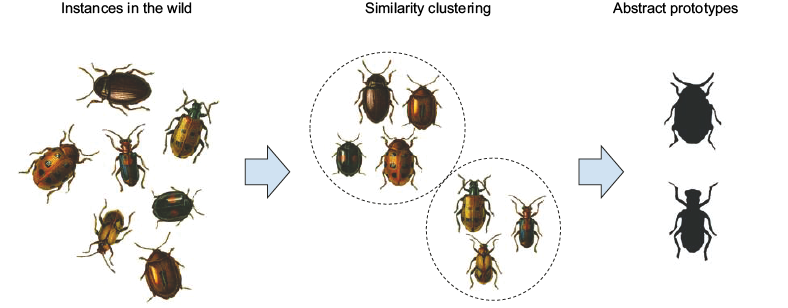
Visualizes how continuous similarity relates instances and produces abstract prototypes. section 19.4.1
Figure 19.13 Program-centric analogy identifies and isolates isomorphic substructures across different instances.
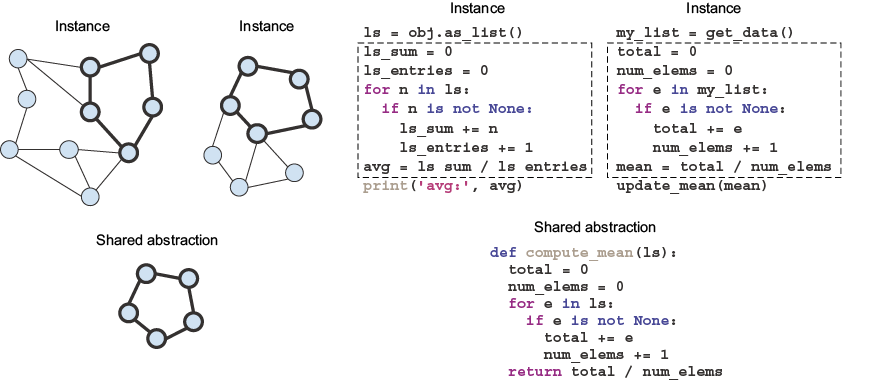
Visualizes how exact structural matching isolates shared substructures across instances. section 19.4.1
Table 19.1 The two poles of abstraction
| Value-centric abstraction |
Program-centric abstraction |
|---|---|
| Relates things by distance |
Relates things by exact structural match |
| Continuous, grounded in geometry |
Discrete, grounded in topology |
| Produces abstractions by “averaging” instances into “prototypes” |
Produces abstractions by isolating isomorphic substructures across instances |
| Underlies perception and intuition |
Underlies reasoning and planning |
| Immediate, fuzzy, approximative |
Slow, exact, rigorous |
| Requires a lot of experience to produce reliable results |
Experience efficient: can operate on as few as two instances |
Compares value-centric and program-centric abstraction by relation, representation, speed, experience demands, and cognitive role. section 19.4.2














