Hinge loss is a classification loss that stops rewarding improvement once the correct class satisfies a score criterion. Unlike softmax cross-entropy, it does not keep pushing scores toward an unattainable ideal after the correct class is sufficiently favored. section 9.1.8 section 9.4
For a training pair with ground-truth class c, class scores y, and margin m, multiclass SVM hinge loss sums the violations from incorrect classes: max(0, yj − yc + m) for each j ≠ c. The max operation creates the hinge: satisfied constraints contribute zero, while violations contribute increasingly larger loss. section 9.1.8
Interpret the score comparison as follows:
- Good output: an incorrect score below the correct score contributes zero without distinguishing among already-good score configurations. section 9.1.8
- Bad output: an incorrect class that scores too close to or above the correct class contributes positive loss, encouraging separation. section 9.1.8
- Margin-based training can require the correct score to exceed each incorrect score by a fixed amount, commonly m = 1. section 9.1.8
Image classification scores
Suppose an image classifier scores cat, dog, airplane, and automobile classes. With cat as the ground-truth class, hinge loss compares the cat score against every incorrect-class score, penalizing only comparisons that fail the required margin. section 9.1.8
Figure 9.5 Hinge loss for good and bad output predictions
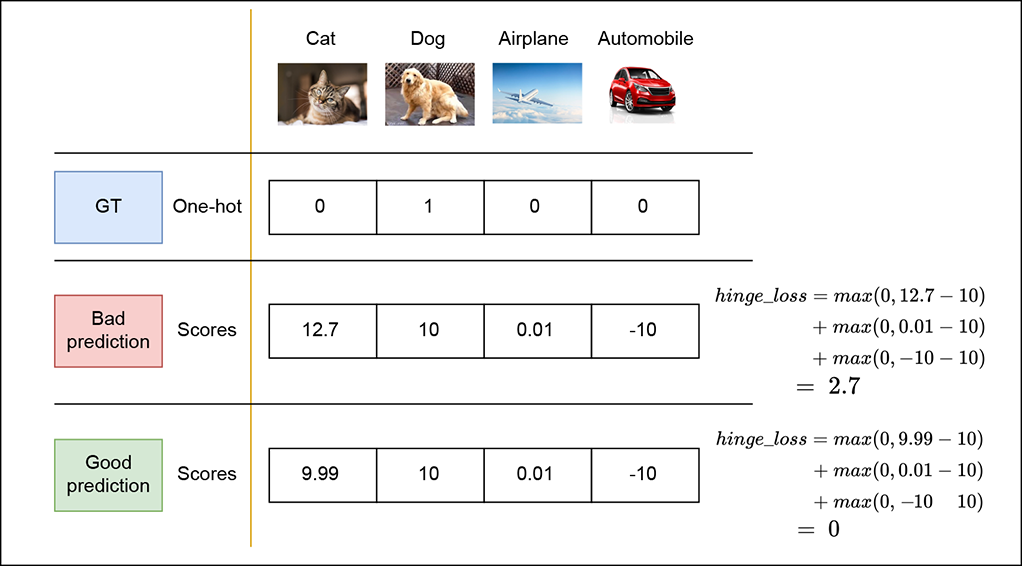
Use the good-and-bad prediction figure to visualize the hinge's zero region and its positive-loss region. section 9.1.8

