A hit is a compound that shows measurable binding affinity or activity against a selected biological target during discovery screening. Screening may be computational, such as virtual screening, or experimental, such as high-throughput assays. section 1.4.1
The target-to-hit stage searches a large, diverse compound library for molecules that attach to the target and may change its function. For an enzyme, an inhibitor can block conversion of a substrate into a product; unintended binding to other biomolecules is an off-target effect. section 1.4.1
Hits are provisional discoveries, not finished drug candidates:
- Multiple hits usually undergo in vitro, confirmatory, and ADMET assays before the most promising compounds become leads. section 1.4.2
- Assessment considers potency, efficacy, selectivity, pharmacokinetic properties, pharmacodynamic properties, and toxicity. section 1.4.2
- Lead optimization modifies promising compounds while retaining their core molecular structure to improve potency, selectivity, and ADMET properties. section 1.4.2
Virtual screening for antimalarial hits
A virtual-screening pipeline can search a compound library for molecules with promising antimalarial activity, narrowing a large chemical space to candidates for subsequent testing. section 2.1
Figure 1.13 We can segment the early drug discovery pipeline into four main phases: target identification, hit discovery, hit-to-lead or lead identification, and lead optimization. Target identification designates a valid target whose activity is worth modulating to address some disease or disorder. Hit discovery uncovers chemical compounds with activity against the target. Lead identification selects the most promising hits and lead optimization improves their potency, selectivity, and ADMET properties to be suitable for preclinical study.
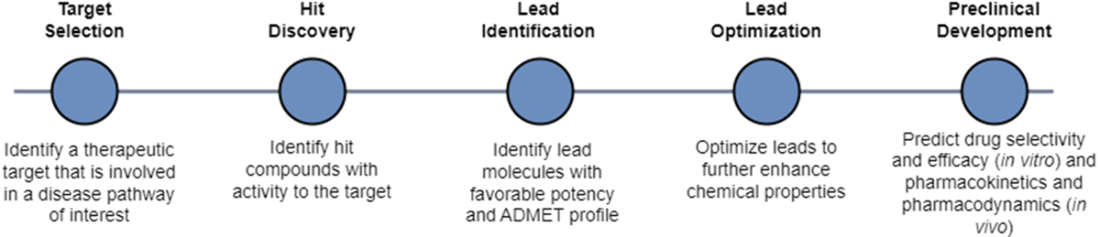
Use the early-discovery pipeline to place hit discovery between target identification and lead identification or optimization. section 1.4.2
