A homogeneous graph contains one type of node and one type of edge. Use this model when every entity and relationship shares the same role, such as candidates connected by relationships in a recruitment network. section 1.2.2
Distinguish it from related graph structures:
- A heterogeneous graph expands the model with multiple node or edge types, such as candidates, companies, and employment relationships. section 1.2.2
- A bipartite graph partitions nodes into subsets and permits connections across subsets, not within the same subset. section 1.2.2
Recruitment network
Represent job candidates as nodes and relationships between candidates as edges. Adding companies and employment links changes the model into a heterogeneous graph. section 1.2.2
Figure 1.2 A homogeneous graph and a heterogeneous graph. Here, the shade of a node or edge represents its type or class. For the homogeneous graph, all nodes are of the same type, and all edges are of the same type. For the heterogeneous graph, nodes and edges have multiple types.
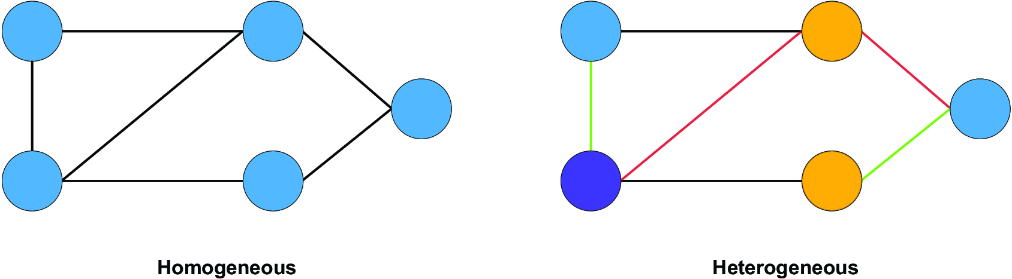
Compare uniform node and edge types with the varied shades representing types in a heterogeneous graph. section 1.2.2
