Homoscedasticity means that variability stays consistent across the groups or predictor values being compared. For a t-test or ANOVA, it is the equal-variance assumption: the populations supplying the samples should vary similarly on the outcome. In regression, it means residuals have a consistent spread across values of the independent variables. section 4.2.1 section 4.3.2
The assumption matters because t-tests and ANOVAs use standard deviation in their calculations. If one group varies much more than another, the calculation can be skewed and its result unreliable. Equal-looking averages alone do not establish that a comparison is sound. section 4.2.1
Check the spread in the form relevant to the analysis:
- For group comparisons, examine whether the groups have substantially different variances. If they do, consider a Welch t-test or ANOVA, or a non-parametric group-comparison test. section 4.2.1
- For regression, plot residuals against predicted values to assess whether their spread stays consistent. If it does not, consider weighted least squares or a square-root or logarithmic transformation of the dependent variable. section 4.3.2
Figure 4.21 Parametric statistics generally assume that your samples have equal variances. In this example, the unequal variance leads to greater overlap between the two distributions.
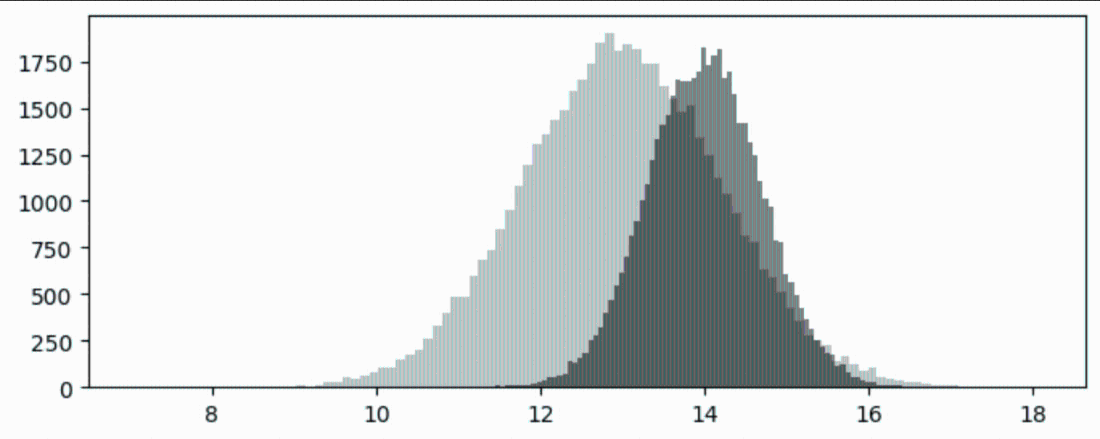
The unequal-variance example shows why comparing group centers is not enough: one distribution has greater spread, creating more overlap between the groups. section 4.2.1


