liveBook · Manning

Homoscedasticity

As explained in Machine Learning System Design

Homoscedasticity is the condition in which the variance of a regression error is constant across predictor or fitted-value levels.

Homoscedasticity means that regression residuals have the same variance across values of the predictor X. Unequal variance is heteroscedasticity and can produce unexpected model behavior after deployment. section 9.2.2

Check the assumption during regression error analysis:

  • Inspect a scale-location plot to assess whether residual variance remains homogeneous. section 9.2.2
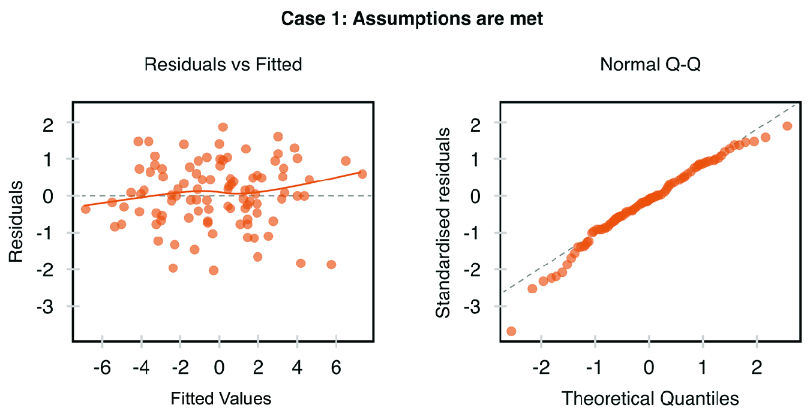
  • Look for a horizontal pattern with evenly dispersed residuals; changing spread indicates nonconstant error variance. section 9.2.2
  • Turn model assumptions into unit tests so later deployments can expose assumption violations. section 9.2.2

Demand forecasting

A simple linear regression for demand forecasting assumes homoscedasticity alongside linearity, zero-centered residuals, normality, and independence. Residual diagnostic plots help reveal whether that assumption holds after fitting. section 9.2.2

Figure 9.10 Four diagnostic plots for linear regression’s residual analysis in both cases (Case 1: Assumptions are met)
figure

Compare diagnostic plots for regression cases where assumptions are met or violated. section 9.2.2


How Machine Learning System Design covers it

How deep it goes
Defines constant residual variance and gives scale-location diagnostics, but does not derive statistical tests or remedies.
Examples
Uses demand forecasting and scale-location plots to examine residual variance.
What it assumes
Assumes familiarity with simple linear regression, predictors, fitted values, and residuals.
What you can do after
Diagnose potential heteroscedasticity with residual plots and encode assumption checks as unit tests.
How it connects
Connects homoscedasticity with linear regression, residuals, linearity, normality, independence, and outliers.

Also explained in

Compare how 3 books explain homoscedasticity →

Related concepts

This explainer was generated by Manning's knowledge graph from the text of Machine Learning System Design. The section links point to the parts of the book it draws on.
