liveBook · Manning

Honeybee foraging behavior

As explained in Optimization Algorithms: AI techniques for design, planning, and control problems

Honeybee foraging behavior is the collective process by which bees search for, evaluate, collect, and communicate information about food resources.

Honeybee foraging behavior is a decentralized colony process for searching for, evaluating, collecting, and communicating information about food. Foragers favor rewarding resource patches instead of searching indiscriminately, improving the hive’s overall cost–benefit balance. section 10.4

The behavior combines several coordinated activities:

  • Individual foragers search for food and concentrate effort on high-quality patches. section 10.4
  • Returning foragers recruit nestmates through changed dance patterns when food resources are scarce. section 10.4
  • Colony cooperation supports broader goals, including food gathering, hive construction, thermoregulation, and defense. section 10.4

A colony exploiting scarce food

When available food is scarce, foragers intensify recruitment, mobilizing more nestmates toward profitable sources rather than distributing effort randomly. section 10.4

Figure 10.14 Foraging behavior of honeybees
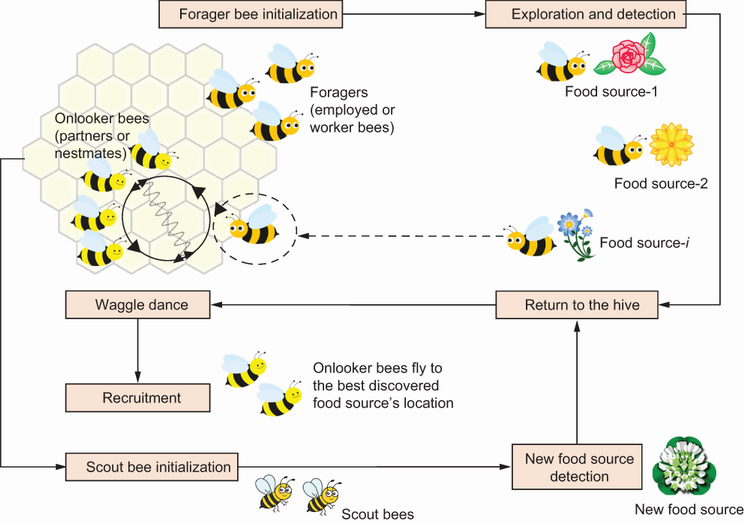
Use the figure to visualize how honeybee foraging behavior organizes collective resource gathering. section 10.4

How Optimization Algorithms: AI techniques for design, planning, and control problems covers it

How deep it goes
Explains resource selection, cost–benefit effort, and scarcity-triggered recruitment through dance patterns.
Examples
Uses rewarding food patches, scarce resources, returning foragers, dance patterns, and large-scale flower visits.
What you can do after
Evaluate how decentralized agents balance exploration, recruitment, and profitable resource exploitation.
How it connects
Connects foraging with swarm intelligence, decentralized control, recruitment, thermoregulation, and colony defense.

Related concepts

This explainer was generated by Manning's knowledge graph from the text of Optimization Algorithms: AI techniques for design, planning, and control problems. The section links point to the parts of the book it draws on.