A forager bee is a worker honeybee that searches for and collects resources such as nectar or pollen. In a colony, forager bees exploit known food sources near the hive, while scout bees explore farther areas for new sources. section 10.4
Foraging follows a practical sequence:
- Search for flowers or other food sources around the hive. section 10.4
- Collect nectar or pollen when a suitable source is found. section 10.4
- Remember the source’s location, distance, direction, flower type, and quality before returning to the hive. section 10.4
This division between exploiting known resources and exploring for better ones inspires the artificial bee colony algorithm, a swarm-intelligence approach to optimization. Worker bees can switch between forager and scout roles as colony needs and resource availability change. section 10.4
Treasure-hunting analogy
Forager bees search nearby areas for promising clues, while scout bees randomly explore farther away. A successful bee returns to base camp and communicates the clue’s location and quality through a waggle dance, allowing onlooker bees to choose promising discoveries. section 10.0
Figure 10.14 Foraging behavior of honeybees
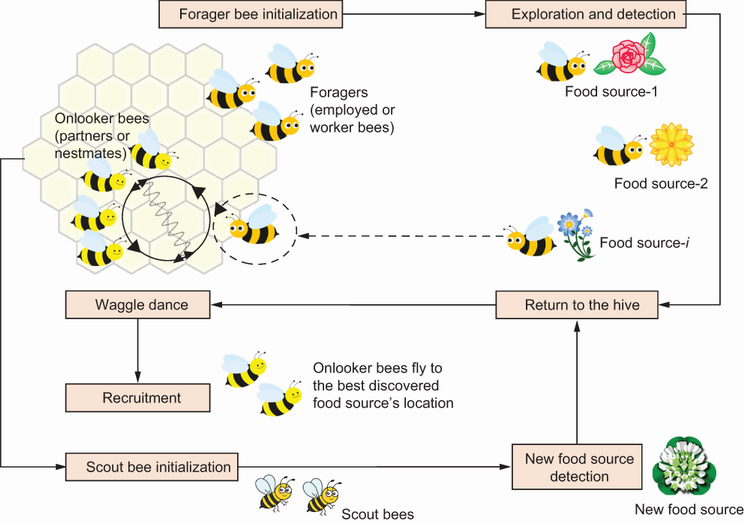
Trace the stages of honeybee foraging from exploration and detection through memorization and return to the hive. section 10.4
