liveBook · Manning

Worker bee

As explained in Optimization Algorithms: AI techniques for design, planning, and control problems

A worker bee is a female honeybee that performs nonreproductive colony tasks such as foraging, construction, storage, and defense.

A worker bee is a female honeybee that performs the colony’s nonreproductive work. Worker bees forage for food, construct and regulate the hive, defend the colony, and communicate discoveries through waggle dances. section 10.4

Worker bees contribute to colony survival through several coordinated tasks:

  • Foraging for nectar and pollen, sometimes visiting hundreds of flowers in a day. section 10.4
  • Building honeycomb cells and supporting efficient storage of pollen, honey, and eggs. section 10.4
  • Maintaining hive temperature and defending the colony. section 10.4

From hive behavior to optimization

The artificial bee colony algorithm models how worker bees search for food sources and share information about promising discoveries, turning collective foraging into a swarm-intelligence strategy. section 10.4

Figure 10.14 Foraging behavior of honeybees
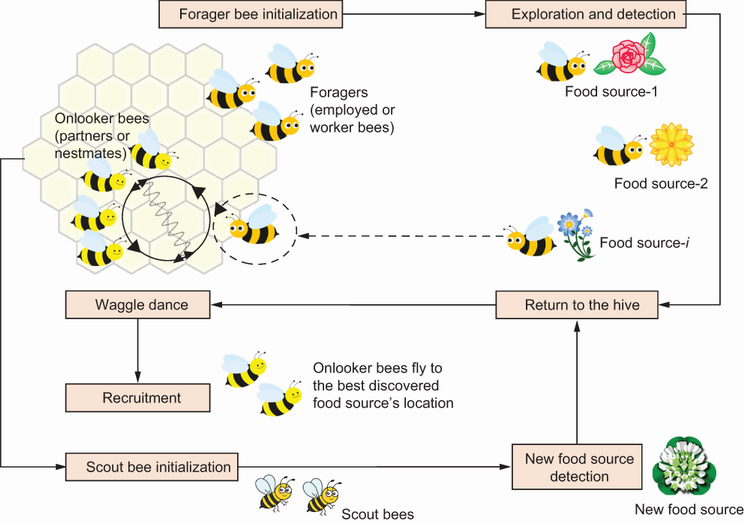
Use the foraging-behavior figure to connect worker-bee activity with the search process modeled by artificial bee colony optimization. section 10.4

How Optimization Algorithms: AI techniques for design, planning, and control problems covers it

How deep it goes
Defines colony roles and observable duties, then connects foraging and communication to an optimization algorithm.
Examples
Uses flower visits, hive construction, thermoregulation, defense, honeycomb cells, and waggle dances.
What you can do after
Understand how worker-bee cooperation motivates swarm-intelligence optimization.
How it connects
Connects worker bees to honeybees, foraging behavior, waggle dance, and artificial bee colony optimization.

Related concepts

This explainer was generated by Manning's knowledge graph from the text of Optimization Algorithms: AI techniques for design, planning, and control problems. The section links point to the parts of the book it draws on.