A forecast horizon is the future span covered by a forecast. In demand planning, its purpose is not simply to produce predictions farther ahead: it identifies the future periods that matter for a decision, such as ordering, production, inventory deployment, product renewal, or cash-flow planning. Choose it from the supply-chain objective and the lead times involved, before trying to improve forecast accuracy. section 6.0 section 1.2.1 section 14.4.1
A lag names a particular position within that horizon. Lag 0 is the current period; for a monthly forecast prepared in January, Lag 1 is February and Lag 2 is March. Treating lags explicitly helps distinguish forecasts that are generated automatically across many periods from the limited periods where planner attention and accuracy measurement are most valuable. section 6.0
Ordering through a supplier lead time
Suppose orders are placed monthly and a supplier quotes a three-month lead time. To decide the order quantity now, attention must extend to demand over the coming four months. The relevant horizon follows the ordering process, rather than an arbitrary preference for a short or long forecast. section 6.3 section 6.0
The appropriate horizon changes with the decision and the audience:
- Logistics may need highly granular forecasts for shipments over the next few days. section 7.1
- Plant management may plan production over the next few weeks. section 7.1
- Marketing may assess product renewal over the next six to nine months, while finance may plan revenue and cash flow for following quarters. section 7.1
- Short-term needs generally call for store-, product-, and day-level detail; longer-term needs generally use aggregates such as region, product family, and month. section 7.1
Do not make every future period equally important merely because a model can populate it. Manufacturers may generate forecasts up to 18 months ahead, yet management may track only selected lags, such as M+2 for production or M+3 and M+12 for mid- and long-term views. Focus review effort on the lags that support the actual decision. section 6.0
The needed treatment also depends on shortage behavior. Where shortages produce both lost sales and backorders, each period must be forecast accurately and estimates must remain sound across the whole risk horizon. Horizon selection therefore connects forecast quality to the operational consequences of being wrong at different future points. section 6.4.3
Figure 6.1 Forecasting lags
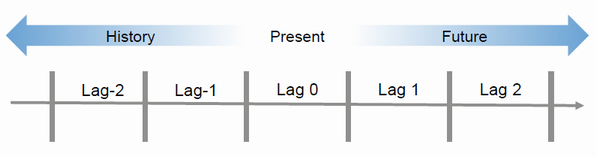
Use the lag diagram to map current and future periods before deciding which forecast positions deserve attention and KPI tracking. section 6.0
