Supplier lead time is the elapsed time between initiating a supply order and receiving the goods. It determines how long inventory must cover expected demand, so changes in delivery timing directly affect safety stocks and order quantities. section 4.2.5
Use supplier lead time to connect supply decisions with inventory protection:
- A quoted 21-day lead time requires safety stock to cover expected demand variation during those 21 days. section 4.2.5
- If delivery shifts from 21 to 28 days, increase protection and likely order more. section 4.2.5
- Longer or more variable lead times can amplify the bullwhip effect as many planners build inventory simultaneously. section 4.2.5
- Supplier collaboration can improve lead-time reliability while providing earlier information about shortages and expected supply. section 4.3.3
A three-month ordering horizon
With a three-month lead time, an order placed at the start of M1 cannot affect stock during M1–M3; it changes M4. If projected M4 stock is 70 units and the target is 100, ordering 80 units restores the target after 50 units of consumption. Updating the M2 forecast from 75 to 100 units increases the current order by 25 units. section 6.2
Figure 4.6 Vicious circle of supply constraints and safety stocks
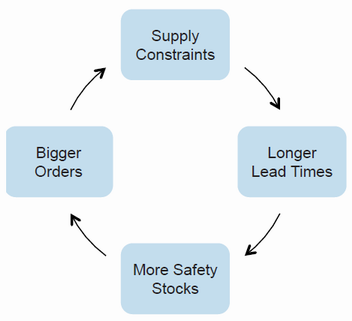
Trace the vicious circle linking supply constraints, longer lead times, higher safety stocks, and increasing orders. section 4.2.5
