Progressive commitment builds confidence before an agent takes consequential action. Within a run, it puts cheaper, reversible checks before commitment. Across runs, it expands or contracts autonomy according to observed outcomes. Evidence must come from the harness and business results, not the agent’s assessment of its own work. section 9.4
Authorization and containment are not proof that an action is correct. An authorized database write can still contain the wrong value; a permitted connection and call count will not reveal that error. A dry run, validation, or staged release can provide cheaper evidence before the write commits. section 9.3.6
Design the commitment path and the trust lifecycle together:
- Choose a sequence of probes that produces relevant evidence before the consequential action. section 9.4
- Set promotion and demotion criteria, and identify decisions that always remain human. section 9.4
- Measure outcomes by task difficulty and trust level, track human overrides, and measure time to demotion after an incident. section 9.4
- Keep a hard ceiling on permitted effects at every trust level. section 9.9
Evidence can be biased: success on easy tasks or probes unlike the live action does not establish readiness for harder commitments. Increasing autonomy therefore requires representative outcomes, while incidents must be able to reduce it. section 9.4
Progressive commitment works alongside other governance controls. An approval gate routes a proposal, blast radius control limits its effects, and an observability harness connects decisions and outcomes into a causal record. The agent’s prompt is not the authority for these controls. section 9.6 section 9.8
Figure 9.6 The governance pipeline. Four patterns coordinate one action from proposal to recorded outcome.
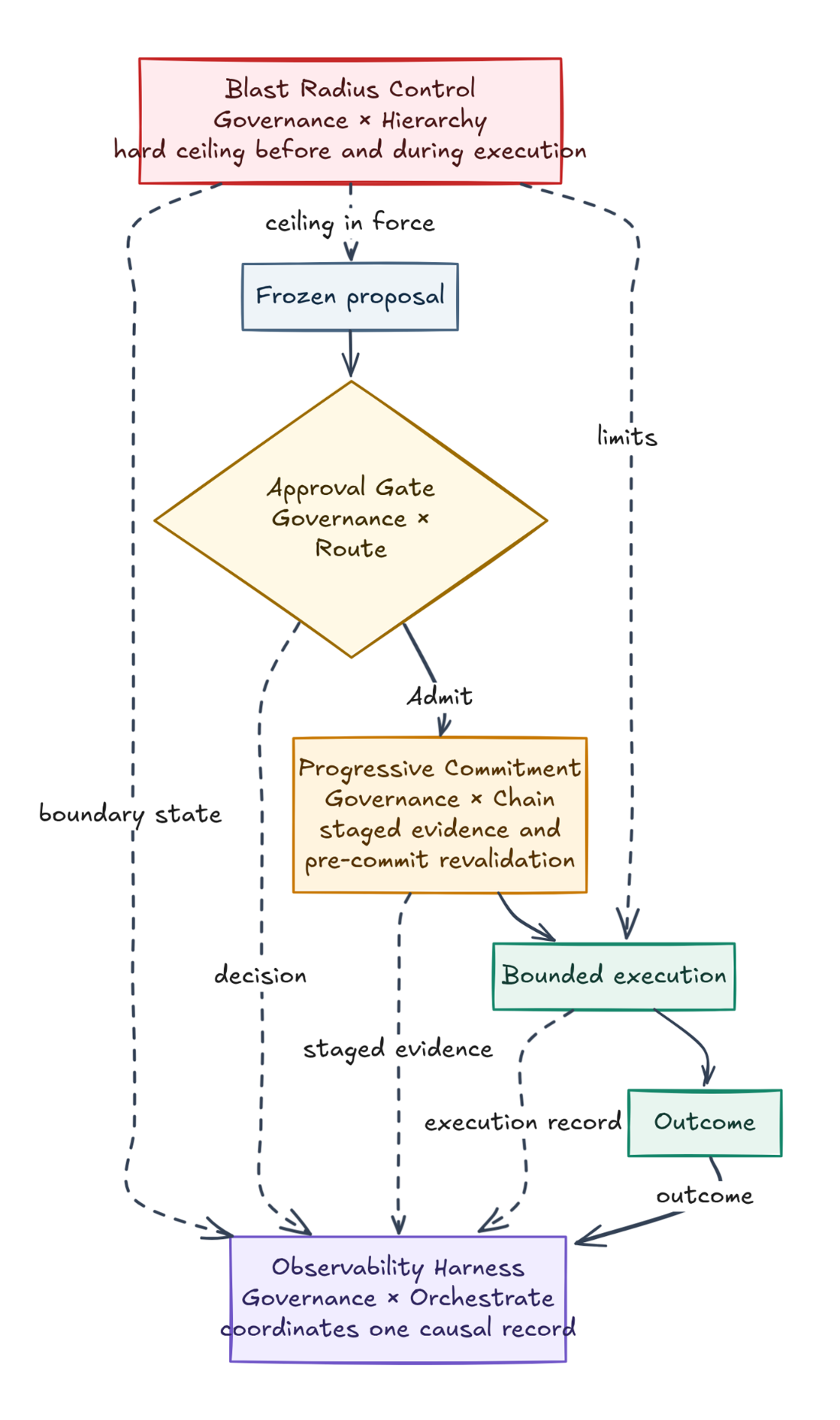
The governance pipeline places staged evidence between proposal routing and recorded outcome, alongside a hard limit on effects. section 9.6
