An Ethernet hub connects hosts in a LAN by repeating incoming electrical signals from one port out of every other port. It operates at Layer 1, does not examine MAC addresses, and gives every connected device every frame. section 8.1.3
Because a hub cannot store frames, simultaneous transmissions collide. All connected hosts share one collision domain and must use half-duplex communication, so only one host can transmit at a time without a collision. section 8.1.3 section 8.4
Compare hub behavior with switched Ethernet:
- A hub repeats signals to all other ports; a switch uses Layer 2 information to forward frames toward their destinations. section 8.1.3
- A hub places every attached device in one collision domain; a switch gives each connected device its own collision domain. section 8.4
- Half-duplex devices use CSMA/CD to detect and handle collisions, while switched wired LANs normally operate in full duplex. section 8.4
Figure 8.2 Four PCs are connected to a hub, and two attempt to transmit at the same time, resulting in collisions. All four PCs are in the same collision domain. (1) PC2 sends a frame addressed to PC1’s MAC address, and PC4 sends a frame addressed to PC3’s MAC address. (2) The hub attempts to flood both frames at the same time, resulting in collisions. Neither PC1 nor PC3 receive their respective frames intact.
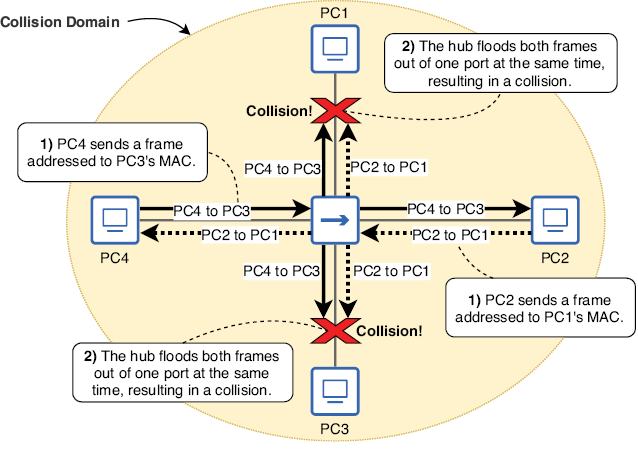
Trace two PCs transmitting simultaneously: the hub floods both frames at once, producing a collision that prevents either destination from receiving an intact frame. section 8.1.3
Recognizing hub-related errors
A collisions counter can be expected when an interface connects to a hub. In a switched LAN it should remain at zero; late collisions often indicate a duplex mismatch. section 8.3
