A marketing team needs a new article. An AI language model can produce a first draft; a person can then add the brand’s tone, priorities, and insights. Human–AI collaboration uses those different strengths together rather than treating AI as a replacement for the person doing the work. section 2.1.1
Design the division of work around the task:
- Identify components suited to AI, such as processing feedback to surface recurring problems, and components that need human intuition or ethical judgment. section 2.1.1 section 3.3.2
- Choose an assisted, augmented, or autonomous degree of automation that fits the business strategy, resources, team expertise, and user workflow. section 3.3.2
- Account for the human time spent finding and correcting errors, as well as the harm from errors nobody catches. Collaboration does not make these costs disappear. section 2.1.1
Supporting a designer
AI can analyze user feedback and flag recurring problems. A human designer decides how to turn those signals into an intuitive interface. Miro similarly uses AI to support brainstorming, diagramming, and synthesis while retaining human creativity and decision-making. section 2.1.1
The interaction matters as much as the allocation of tasks: decide how much automation users should have and how the interface will balance transparency and control. A graphical, conversational, or hybrid interface should serve the workflow, not dictate it. section 2.1.1 section 3.3.2
Figure 2.5 Humans and AI each have different strengths that should be used when
building AI-driven products.
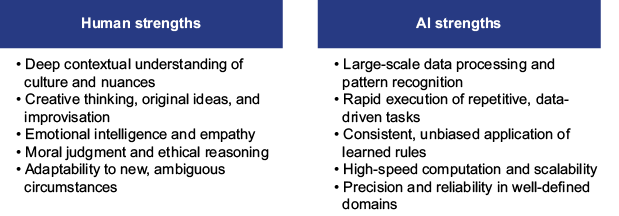
Compare human and AI strengths before deciding which parts of a task each should handle. section 2.1.1

