Human intelligence can be considered through observable abilities such as language, reasoning, adaptability, and creativity, or through the cognitive mechanisms that produce behavior. Similar performance alone does not establish similar mechanisms. section 1.3.4 section 5.4.6
The Turing test makes behavior a practical basis for judging intelligence: a machine imitates a human in written dialogue, and a judge tries to tell them apart. This evaluates interaction, not what happens inside the mind; resemblance therefore does not settle whether imitation amounts to understanding. section 1.3.4 section 5.4.6
General intelligence need not imply:
- Perfect performance, even in areas of competence. section 9.5.1
- The ability to perform every cognitive task. section 9.5.1
- A human-like architecture or superiority to humans across almost every domain. section 9.5.1
Judgments of broad capability are stronger when they accumulate evidence across tasks—from conversation and school-level reasoning to programming, creative work, planning, and research assistance—rather than treating one test as decisive. Comparisons with artificial neural networks should also distinguish outcomes from the mechanisms behind them, including differences in goals, learning, memory, and representation. section 9.5.1 section 5.4.6
Figure 1.5 The Turing Test. A human judge engages in written dialogue with two unseen participants. One is human and the other a machine, but their identities are hidden from the judge. If the judge cannot reliably distinguish the machine from the human based on their responses, the machine is said to pass the test.
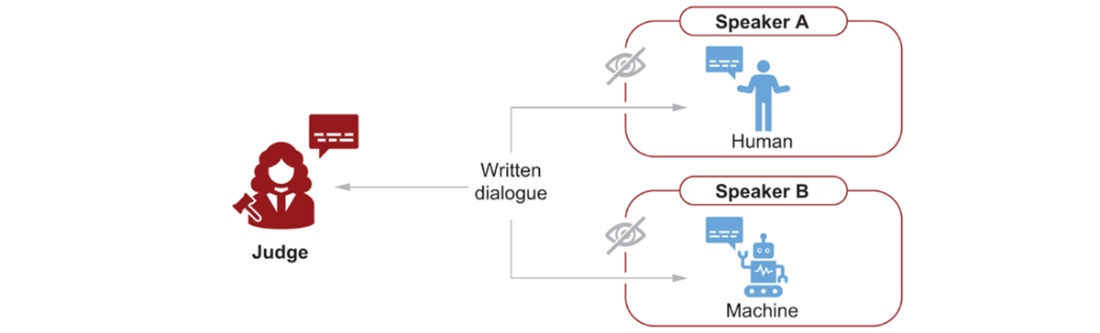
The diagram shows the written-dialogue setup used to judge whether a machine can be distinguished from a human. section 1.3.4
Table 5.1 Key structural differences between human cognition and artificial neural networks. Similar behaviors can emerge in both systems, but they arise from fundamentally different mechanisms governing goals, learning, memory, time, and representation.
|
Dimension
|
Human cognition
|
Artificial neural networks
|
|
Goal formation
|
Arises from internal processes shaped
by needs, intentions, and external context
|
Externally specified as optimization
targets during training
|
|
Learning signal
|
Consequences of actions and
interactions with the environment
|
Numerical loss minimized during
training
|
|
Memory
|
Continuously reshaped through use and
recall
|
Parameters remain fixed between
training runs
|
|
Temporal organization
|
Learning and action unfold together
over time
|
Training and inference generally occur
in separate phases
|
|
Representation
|
Concepts refer to objects and events
in the world
|
Representations capture statistical
structure in data
|
|
Adaptation
|
Development accumulates along an
irreversible history
|
Models can be retrained, reset, or
copied
|
The comparison outlines ways similar behavior can arise from different cognitive and computational structures. section 5.4.6
