The Human Phenotype Ontology (HPO) standardizes observable physical and biochemical abnormalities, their names, identifiers, synonyms, and hierarchical relationships. As a reference schema, it maps heterogeneous clinical data into shared concepts and supports interoperability across sources. section 3.0 section 3.1.2
An HPO-driven knowledge-graph workflow typically proceeds through these stages:
- Inspect hpo.owl as RDF/XML containing phenotype classes, subclass relationships, definitions, synonyms, cross-references, and metadata. section 3.1.2
- Read phenotype.hpoa as tab-separated disease annotations containing HPO identifiers, evidence, references, onset, frequency, aspect, and curation metadata. section 3.1.2
- Load the ontology into Neo4j with Neosemantics, then enrich resources as HpoPhenotype nodes and create identifiers, constraints, and indexes. section 3.3.1
- Create disease nodes and HAS_PHENOTYPIC_FEATURE relationships from the annotation file, preserving the link between diseases and standardized phenotypic features. section 7.6.4
Phenotype-based rare-disease search
A clinician can query Type 1 diabetes and retrieve its associated features, then combine it with growth delay, large knee, sensorineural hearing impairment, and pruritus. Ranking diseases by matched features surfaces Ondontochondrodysplasia 2 with hearing loss and diabetes as the top match. section 3.4
Ontology-based inference
Subclass traversal extends direct matching: querying the HPO category “Abnormality of the endocrine system” can retrieve diseases annotated with more specific endocrine phenotypes, including thyroid-related abnormalities. section 3.5
Figure 3.1 Mental model of the KG construction process as a specification of the CRISP-DM model, from understanding the business goal to defining the KG queries that support clinicians’ activities
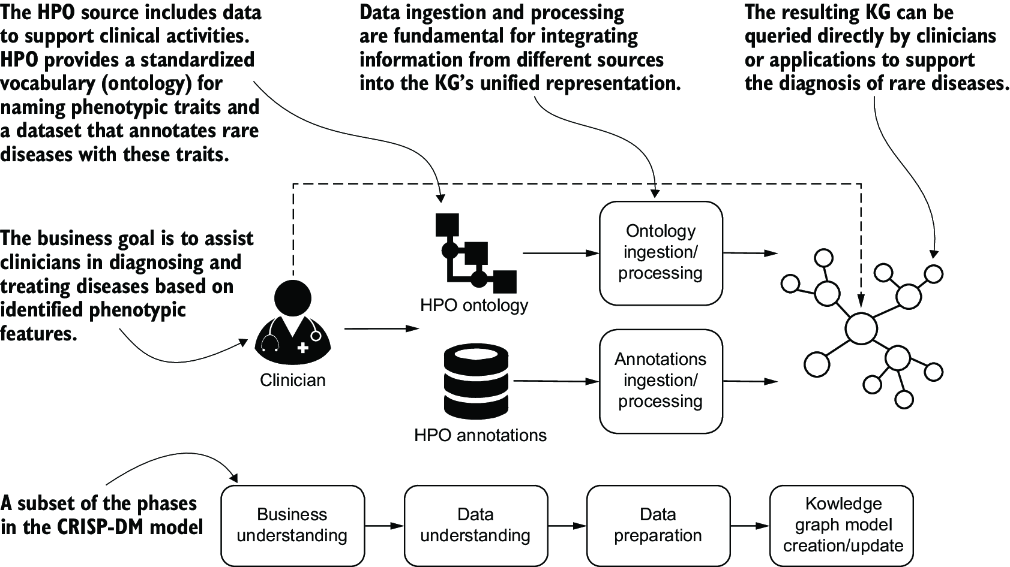
Use the mental model to follow the pipeline from clinical goals and data preparation through knowledge-graph construction, querying, and clinician support. section 3.0
