Hybrid encryption combines fast symmetric encryption with public-key encryption: AES protects the content, while RSA protects the AES key. This avoids using RSA for large data, where its CPU-intensive mathematics is slow. section 6.3.2 section 6.5
A sender and recipient perform these steps:
- Generate a random AES content encryption key (CEK). section 6.3.2
- Encrypt the content with AES using the CEK. section 6.3.2
- Wrap the CEK by encrypting it with the recipient’s RSA public key. section 6.3.2 section 6.5
- Send the encrypted content and encrypted CEK; the recipient uses the RSA private key to unwrap the CEK, then decrypts the content with AES. section 6.3.2
Choosing the algorithms
Use AES for bulk data, such as AES-GCM with a 256-bit key, and RSA-OAEP for wrapping the CEK. Use RSA keys of at least 2,048 bits; avoid the older RSAES-PKCS1-v1_5 padding. section 6.3.2 section 6.5
Figure 6.5 Hybrid encryption uses a high-performance symmetric algorithm such as AES to encrypt content. Then the AES CEK is encrypted with the recipient’s RSA public key, allowing the recipient to use their private key to first the CEK and then decrypt the content.
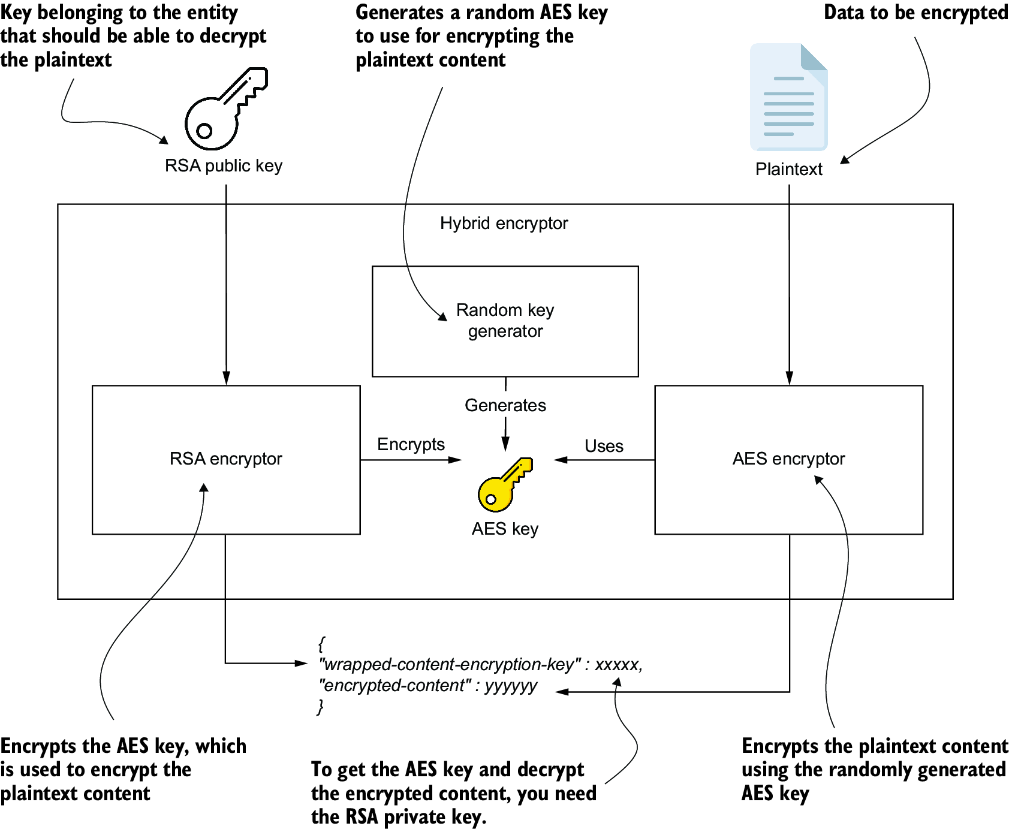
The diagram traces AES content encryption, RSA CEK wrapping, transmission of both encrypted values, and the recipient’s reverse process. section 6.3.2

