RSA
RSA is a public-key cryptosystem based on the computational difficulty of factoring large composite integers and supporting encryption and digital signatures.
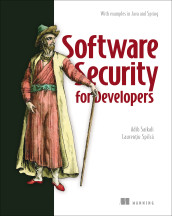
Software Security for Developers
RSA is a public-key cryptographic algorithm based on the computational difficulty of factoring large integers.
- How it is used
- Secures application communication, encrypts keys, signs data, and supports TLS-related public-key operations.
- How deep it goes
- Explains key pairs, factoring, padding, hybrid workflows, and Java usage while deferring mathematical proofs and production certificates.
- Examples
- Uses ACME warehouse and payments services, refunds.json, Java key generation, chunked OAEP encryption, and SHA256withRSA signatures.
- What you can do after
- Apply RSA via Java libraries to generate keys, encrypt and decrypt data, wrap AES keys, and create or verify signatures.
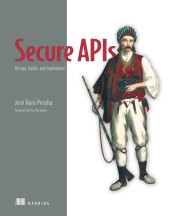
Secure APIs
RSA is a public-key cryptosystem based on the computational difficulty of factoring large integers.
- How it is used
- Uses RSA to issue JWTs with private-key signatures and to encrypt JWE content-encryption keys.
- How deep it goes
- Explains RSA through JWT signing, key generation, private-key loading, and JWE placement, without developing factoring mathematics.
- Examples
- Demonstrates OpenSSL key generation, Python key loading, and PyJWT issuance of a PS256-signed token.
- What you can do after
- Apply it via OpenSSL, cryptography, and PyJWT to generate RSA keys and issue PS256-signed JWTs.
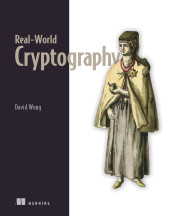
Real-World Cryptography
RSA is a public-key cryptosystem based on the difficulty of factoring large composite integers and supporting encryption and digital signatures.
- How it is used
- Uses RSA for asymmetric encryption, digital signatures, and encapsulating symmetric keys in hybrid exchanges.
- How deep it goes
- Explains public-key roles and modular exponentiation with e, d, and N, while warning that naive implementations and standards can fail.
- Examples
- Uses Queen Alice’s encrypted chest, signed trust statement, modular example m = 2, and symmetric-key encapsulation.
- What you can do after
- Evaluate RSA encryption, signatures, and key encapsulation while recognizing the risks of naive implementations and changing protocol preferences.
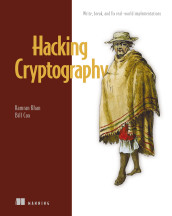
Hacking Cryptography
RSA is a public-key cryptosystem whose security relies on the difficulty of factoring a product of large primes.
- How it is used
- Uses integer factorization as a trapdoor for public-key encryption and message exchange.
- How deep it goes
- Explains key notation and modular encryption and decryption, then emphasizes implementation failures without detailing individual exploits.
- Examples
- Uses trial division of 764,512, Alice-and-Bob message exchange, RSA equations, and shared-prime weak-key detection.
- What you can do after
- Evaluate RSA implementations for factoring strength, randomness failures, deterministic encryption, and unsafe private exponents.
Related concepts
- factorizationuses · Factorization is the decomposition of a mathematical object, such as an integer or joint distribution, into simpler multiplicative factors.
- rsa-pssused by · RSA-PSS is a probabilistic RSA digital-signature scheme using the probabilistic signature scheme encoding specified by PKCS #1.
- digital signatureimplements · A digital signature is cryptographic data generated with a private key and verified with corresponding public information to authenticate data or its signer and detect alteration.
- quantum computercontrasts with · A quantum computer is a computing device that processes information using quantum-mechanical states and operations.
- textbook rsaincludes · Textbook RSA is an unpadded RSA method that directly applies modular exponentiation to a message representative for encryption or signing.
- hybrid encryptionuses · Hybrid encryption combines asymmetric cryptography or key exchange for protecting a symmetric key with symmetric authenticated encryption for protecting data.
These guides are generated from the text of Manning books by Manning's knowledge graph and link to the sections they draw on. The full books are available on liveBook and at manning.com.