RSA is a public-key cryptographic algorithm based on the difficulty of factoring large integers. It uses a related public–private key pair: share the public key, but keep the private key secret. This solves the key-distribution problem because services no longer need to share the same secret key. section 6.2 section 6.3
Figure 6.3 A key pair, consisting of a private and a public key. The keys are numbers that are related by means of a mathematical equation. The private key works only with the public key in the same key pair, and the public key works only with the private key from the same key pair. The private key must be kept secret, but the public key can be shared with anyone, including friends, enemies, and hackers. Security in a public key cryptosystem depends on keeping private keys private.
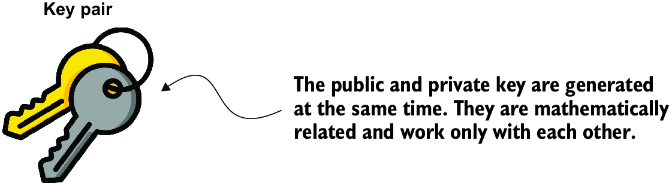
Use the key-pair diagram to distinguish the shareable public key from the secret private key and understand which operations each key performs. section 6.2
Use RSA according to the operation:
- Encrypt with the recipient’s public key and decrypt with the matching private key. section 6.4
- Sign with the private key and verify with the matching public key; signatures provide integrity, authenticity, and nonrepudiation. section 6.4 section 6.6
- Prefer RSA-OAEP for encryption, reject RSAES-PKCS1-v1_5, and choose key sizes according to current security standards; 3,072 or 4,096 bits are recommended for long-term security. section 6.3.1
Warehouse-to-payments encryption
A warehouse service encrypts refunds.json with the payment service’s RSA public key; the payment service decrypts it with the private key. In Java, generate the pair with KeyPairGenerator, configure OAEP, and process data in chunks because RSA cannot encrypt arbitrarily large content. section 6.4
Figure 6.5 Hybrid encryption uses a high-performance symmetric algorithm such as AES to encrypt content. Then the AES CEK is encrypted with the recipient’s RSA public key, allowing the recipient to use their private key to first the CEK and then decrypt the content.
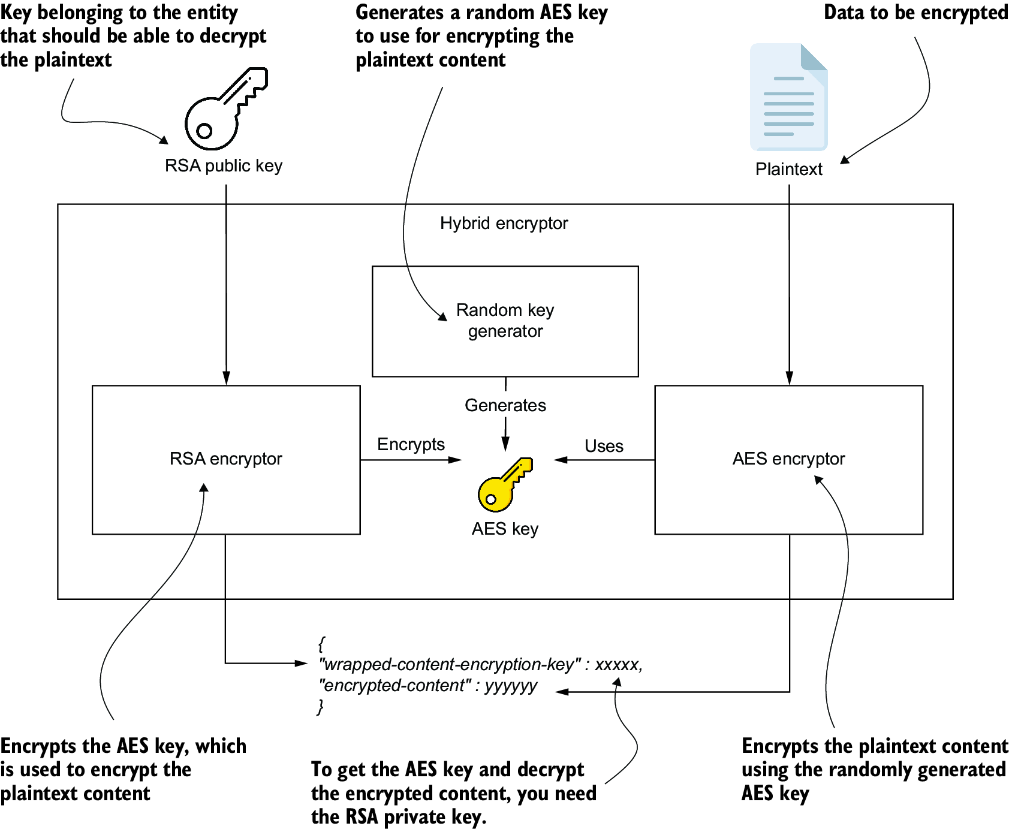
Use the hybrid-encryption diagram to see why RSA normally wraps an AES content-encryption key instead of encrypting large content directly. section 6.3.2
Hybrid encryption combines fast AES for the content with RSA-OAEP for wrapping the randomly generated AES key. TLS, IPsec, JWE, and SSH use this pattern. Protect private keys carefully, replace a compromised pair, and use certificates to validate that a public key belongs to the claimed service. section 6.3.2 section 6.5



