ICMPv6 is the control and diagnostic messaging system for IPv6. Neighbor Discovery Protocol (NDP) is a component of ICMPv6 and uses its messages for address resolution, router discovery, and related functions. section 21.1.2 section 21.4
Important ICMPv6 message types include:
- Echo Request (128) and Echo Reply (129) support IPv6 ping. section 21.1.2
- Neighbor Solicitation (135) and Neighbor Advertisement (136) replace IPv4 ARP request and reply behavior. section 21.1.2 section 21.4
- Router Solicitation (133), Router Advertisement (134), and Redirect (137) support NDP router functions. section 21.1.2
IPv6 does not use broadcast for address resolution. A host sends an NS message to the neighbor’s solicited-node multicast address, and the neighbor returns a unicast NA containing its MAC address. The resulting Layer 3–Layer 2 mapping appears in the IPv6 neighbor table. section 21.1.2 section 21.4
Verify IPv6 neighbor resolution
After R1 pings 2001:db8::2, show ipv6 neighbors displays R2’s global and link-local addresses, their MAC address, REACH state, and Gi0/0 interface. section 21.1.2
Figure 21.2 An NDP exchange between two routers. R1 sends an NS message to learn R2 G0/0’s MAC address, and R2 sends an NA message in response.
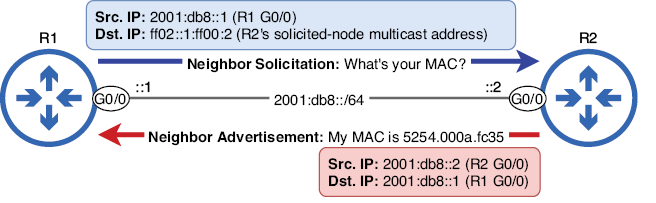
Trace the NS request and NA response between two routers. section 21.1.2
