Neighbor Discovery Protocol (NDP) is IPv6’s replacement for ARP. It maps IPv6 Layer 3 addresses to MAC addresses and also discovers routers, link prefixes, and duplicate addresses. section 21.1 section 21.4
NDP uses ICMPv6 messages and local-link multicast for several jobs:
- Address resolution uses Neighbor Solicitation (NS, type 135) to request a MAC address and Neighbor Advertisement (NA, type 136) to return it. NS messages target the neighbor’s solicited-node multicast address rather than a broadcast. section 21.1.2
- Router discovery uses Router Solicitation (RS, type 133) sent to ff02::2 and Router Advertisement (RA, type 134), typically sent to ff02::1. section 21.1.3
- Router Advertisements provide information such as the network prefix and support Stateless Address Autoconfiguration (SLAAC), allowing a host to generate its own IPv6 address and learn a default gateway. section 21.1.3
- Duplicate Address Detection (DAD) checks whether an IPv6 address is already in use before the host uses it. section 21.4
Resolving a neighbor and verifying the result
After R1 pings R2’s IPv6 address, `show ipv6 neighbors` displays Layer 3-to-Layer 2 mappings. The output can include R2’s global and link-local addresses, the same MAC address, a REACH state, and interface Gi0/0. section 21.4
Figure 21.3 R2 uses SLAAC to generate an IPv6 address. (1) Issue the ipv6 address autoconfig command. (2) R2 sends an RS message. (3) R1 responds with an RA message. (4) R2 combines the learned prefix with a Modified EUI-64 interface ID to make its IPv6 address.
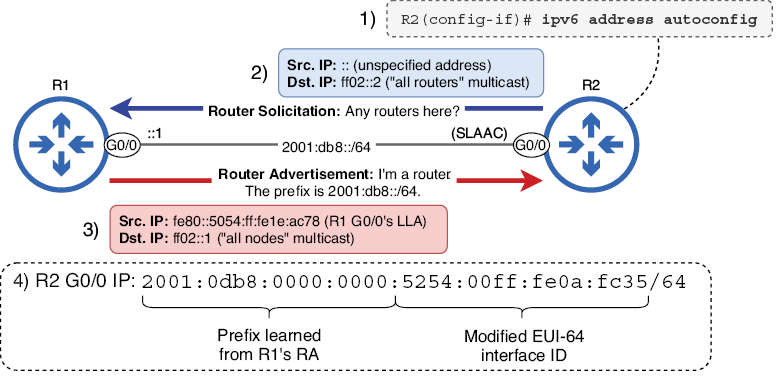
Follow the RS-to-RA exchange and see how SLAAC combines a learned prefix with a Modified EUI-64 interface identifier. section 21.1.3
