liveBook · Manning

Neighbor advertisement

As explained in Acing the CCNA Exam: Volume 1 Fundamentals and Protocols

A Neighbor Advertisement is an ICMPv6 message that communicates a neighbor's link-layer address or indicates that an IPv6 address is already in use.

A Neighbor Advertisement (NA) is an ICMPv6 type 136 message used by IPv6 Neighbor Discovery Protocol (NDP) to provide a neighbor’s link-layer address. It serves the ARP-reply role in IPv6 address resolution and can also indicate that an IPv6 address is already in use. section 21.1.2 section 21.4

The address-resolution exchange works as follows:

  • A host sends a Neighbor Solicitation (NS) message to the target’s solicited-node multicast address. section 21.1.2
  • The target replies with a unicast NA message containing its MAC address. section 21.1.2
  • The host stores the IPv6-to-MAC mapping in its IPv6 neighbor table. section 21.4

Verify the learned neighbor

After R1 pings 2001:db8::2, the command show ipv6 neighbors displays R2’s global and link-local addresses mapped to MAC address 5254.000a.fc35 on Gi0/0, both in REACH state. section 21.1.2

Figure 21.2 An NDP exchange between two routers. R1 sends an NS message to learn R2 G0/0’s MAC address, and R2 sends an NA message in response.
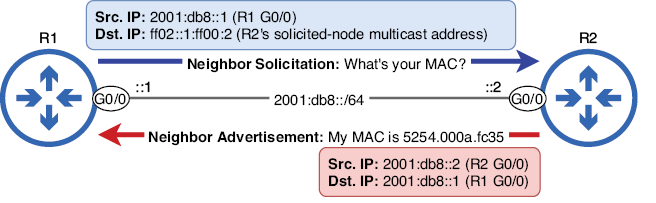
Use the exchange diagram to trace R1’s NS request and R2’s unicast NA response. section 21.1.2

How Acing the CCNA Exam: Volume 1 Fundamentals and Protocols covers it

How deep it goes
Defines the message type, multicast-to-unicast exchange, and neighbor-table result, but does not detail packet fields.
Examples
Shows R1 learning R2’s MAC address through an NS/NA exchange and verifying entries with show ipv6 neighbors.
What it assumes
Assumes basic IPv6 addressing and introduces NDP as IPv6’s ARP-like address-resolution mechanism.
What you can do after
Diagnose IPv6 neighbor resolution by using ping and show ipv6 neighbors to confirm learned Layer 3-to-Layer 2 mappings.
How it connects
Connects NDP with ICMPv6, Neighbor Solicitation, ARP, solicited-node multicast, and the IPv6 neighbor table.

Related concepts

This explainer was generated by Manning's knowledge graph from the text of Acing the CCNA Exam: Volume 1 Fundamentals and Protocols. The section links point to the parts of the book it draws on.