A unicast frame carries a network message from one sender to one destination host. Ethernet switches use the destination MAC address to decide where to send it. section 6.3.2
A switch handles unicast frames in two ways:
- Known unicast: the destination MAC address exists in the MAC address table, so the switch forwards the frame through the associated port. section 6.3.2
- Unknown unicast: the destination MAC address is absent, so the switch floods the frame through every port except the receiving port. section 6.3.2
- Switches learn source MAC addresses from received frames, then use those dynamic entries to forward later traffic more efficiently. section 6.6
Figure 6.4 PC1 sends a unicast frame to PC3, but neither SW1 nor SW2 have an entry for the destination MAC address in their MAC address table. (1) PC1 sends the frame, and SW1 learns PC1’s MAC address. (2) SW1 floods the frame. SW2 learns PC1’s MAC address. PC2 drops the frame. (3) SW2 floods the frame. PC4 drops the frame. PC3 receives and processes it.
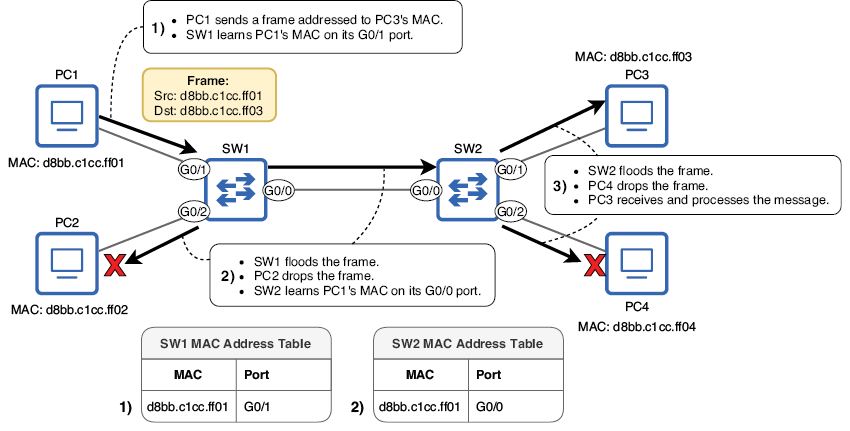
Trace an unknown unicast from PC1 to PC3 as switches learn the source address, flood the frame, and deliver it to the destination. section 6.3.2
Why the first delivery may flood
When PC1 sends to PC3 before the switches know PC3’s MAC address, SW1 and SW2 flood the frame. PC2 and PC4 discard it; PC3 processes it. PC3’s reply lets both switches learn its MAC address, enabling direct forwarding afterward. section 6.3.2 section 6.6
